


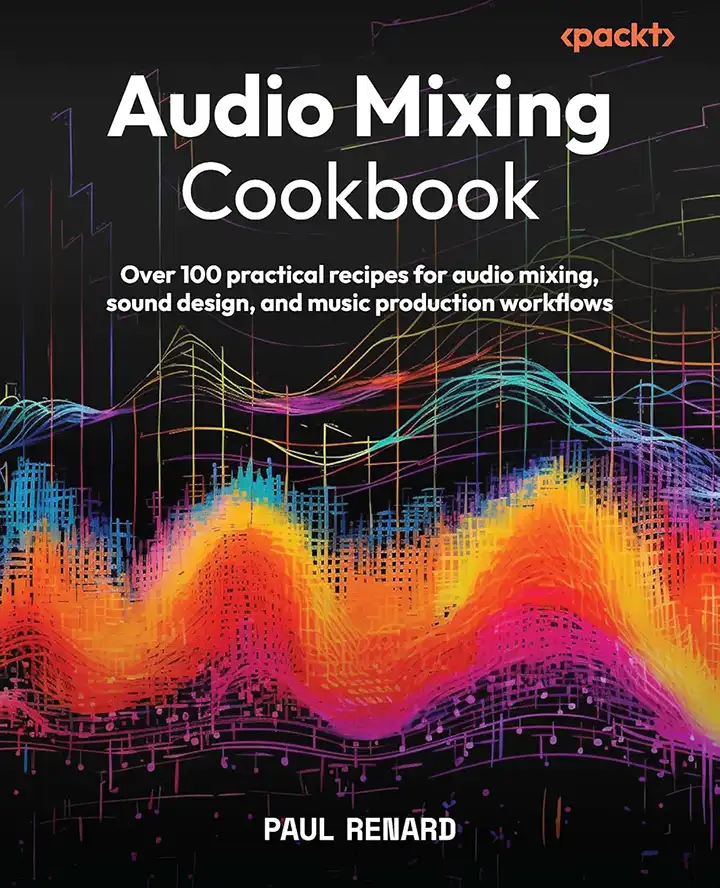
- Product: Audio Mixing Cookbook: Over 100 practical recipes for audio mixing, sound design, and music production workflows
- Author: Paul Renard
- Publisher: Packt Publishing
- Format: PDF
- Print length: 298 pages
- ISBN: 1836649215
- Publication date: March 31, 2026
- Language: English
- Source: amazon.com/Audio-Mixing-Cookbook-practical-production
Audio Mixing Cookbook by Paul Renard is a practical mixing guide built around step-by-step “recipes” for recording, sound design, and mixing. It covers the full production workflow—from studio setup to final mix—emphasizing repeatable processes and decision-making rather than theoretical depth, making it suitable for producers seeking structured, actionable mixing techniques.
Key Takeaway
Audio Mixing Cookbook is not about teaching mixing from first principles—it’s about giving you repeatable workflows you can apply immediately. Its value comes from structured decision-making rather than deep technical theory.
Step-by-Step Mixing Decisions Instead of Abstract Concepts
Most mixing books fall into two categories:
either deep theory (why things work) or broad philosophy (how to think about mixing).
Audio Mixing Cookbook sits in a different lane. It’s built around practical “recipes”—repeatable processes you can apply directly to a mix rather than abstract explanations.
The core idea is simple: Mixing is a series of decisions you can systematize.
Instead of telling you “use EQ to clean mud,” it walks through specific workflows like:
- setting up a session
- shaping tone with EQ and filters
- controlling dynamics with compression
- building depth with reverb and delay
The structure mirrors an actual mix process—from raw recording to finished result.
Structured Workflow From Recording to Final Mix
The book doesn’t start at mixing—it starts earlier.
It covers:
- studio setup and monitoring environment
- recording techniques that affect mix quality
- session organization and DAW workflow
Then it moves into mixing stages:
- balance and level setting
- EQ and filtering decisions
- dynamics control
- spatial processing (reverb, delay)
- automation and final polish
This matters because a lot of beginner problems aren’t mixing problems—they’re bad input decisions.
The “Recipe” Model
The key structural idea is recipe-based learning.
Instead of chapters that explain concepts in isolation, it gives:
- specific scenarios
- a sequence of actions
- expected results
For example, instead of saying:
“use compression for punch,”
the approach is closer to:
- start with threshold X
- adjust attack to shape transients
- use release to control groove
This makes it:
- easier to apply immediately
- less dependent on prior theory
- more repeatable across projects
What It Actually Teaches (Without Overpromising)
The book focuses on decision-making clarity, not magic tricks.
Key areas:
- recognizing when a mix is “finished”
- avoiding over-processing
- choosing tools based on context
- developing a consistent workflow
One of the more grounded ideas: There is no perfect mix—only a mix that works.
That framing matters more than any plugin chain.
Where It Fits Compared to Other Mixing Books
If you compare it to something like:
- Mixing Audio: Concepts, Practices, and Tools
That book is:
- theory-heavy
- deep on concepts
- structured academically
While Audio Mixing Cookbook is:
- workflow-first
- practical
- focused on execution
From community discussions, engineers often recommend books like Izhaki or Owsinski for foundations, while more practical guides are valued for application: “covers basically everything… still reference that book”
That tells you something important: Books don’t replace practice—they shape how you approach it.
A Practical Mixing Guide That Trades Depth for Usability
This book is strongest when:
- you already understand basic tools
- you want clearer workflow structure
- you struggle with finishing mixes
It is weaker if you’re looking for:
- deep signal theory
- psychoacoustics
- advanced engineering concepts
It’s a “do this, hear this result” type of resource—not a deep dive into why.
FAQs
-
Is this book good for beginners?
Yes—but best for intermediate beginners who already understand basic tools like EQ and compression.
-
Does it teach mixing theory?
Not deeply. It focuses more on practical workflows and application.
-
Is it better than classic mixing books?
Not better—different. It’s more hands-on, less theoretical than traditional references.
-
Can you learn mixing just from this book?
No. It helps structure your process, but mixing still requires critical listening and practice.
Audio Mixing Cookbook
Audio Mixing Cookbook by Paul Renard is a practical mixing guide built around step-by-step “recipes” for recording, sound design, and mixing. It covers the full production workflow—from studio setup to final mix—emphasizing repeatable processes and decision-making rather than theoretical depth, making it suitable for producers seeking structured, actionable mixing techniques.
URL: https://plugincrack.com/pdf/audio-mixing-cookbook/
Author: Paul Renard
4.4