


- Product: New Orleans EZX
- Publisher: Toontrack
- Version: 1.0.0
- Format: EZX Sound Expansion
- Requirements: EZdrummer 3, Superior Drummer 3
- Source: toontrack.com/product/new-orleans-ezx
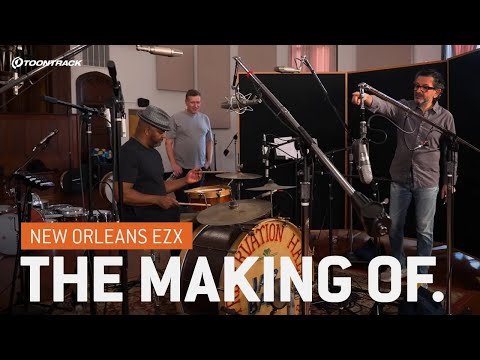
The New Orleans EZX is a drum sound expansion for EZdrummer 3 or Superior Drummer 3, released in October 2025. It contains five kits—spanning early 1900s archive pieces through modern setups—recorded at Esplanade Studios in New Orleans and curated by Terence Higgins, a session/touring drummer with credits including Dr. John, Allen Toussaint, and the Dirty Dozen Brass Band. The library is split into Traditional (historical instruments, rare percussion) and Artist (1950s-onward inspired) sections. Total download footprint: approximately 16.5 GB.
Key Takeaway
The straightforward question: Does this collection serve its stated purpose—capturing authentic New Orleans drum character—without marketing hype clouding the actual sonic and practical reality?
The New Orleans EZX delivers what it promises: authentic New Orleans drum character, captured in a proper studio by competent engineers, using genuinely historical instruments alongside modern pieces. The choice to embrace tonal warmth and room ambience over clinical polish is coherent. The included MIDI and presets are usable and authentic to their style.
The software limitation—EZdrummer’s basic mixer—is not the product’s failure; it’s inherent to EZdrummer 3 itself. Producers aware of this trade-off can make informed choices. Superior Drummer 3 users gain full access to the same sounds plus deep mixing control.
This is not a general-purpose expansion. It’s a specialist tool for producers working in specific genres who value tonal authenticity over versatility. Judged on that basis, it performs its job credibly.
Recording Environment & Capture
The recordings took place at Esplanade Studios, a 14,000-square-foot church-turned-studio in the Tremé neighborhood. Studio A’s main room measures 3,400 sq ft with 26-foot ceilings. The drums were partially isolated with gobos, yielding what Toontrack describes as “lively yet viscerally close” tone—a deliberate choice to avoid excessive room smear while preserving character.
Engineer Misha Kachkachishvili, who operates the facility and has worked with Jon Batiste and Dr. John, mixed the captures. This is verifiable context: the studio’s acoustics and engineering competence are established facts, not claims. The setup inherently suggests you’re hearing drums captured in a controlled but not clinical manner—neither a dead isolation box nor a cathedral reverb soak.
Sonic Character: What’s Actually Different
In departure from other Toontrack expansions—which often emphasize clarity and polish—this library leans toward rawness. The Traditional kit, sourced from the New Orleans Jazz Museum and Preservation Hall, exhibits:
- Bass drums: Open, ringing tone with pronounced decay. They lack the tight, kick-forward character of modern studio processing. They breathe.
- Snares: Described as having a “dark, subdued and papery snap”—not crack, not attack-heavy, but dry and contained. Likely vintage heads with less shimmer than contemporary snare designs.
- Cymbals: Sabian HHX Complex series (Medium voice), which are known for complexity and bell content. Not bright or cutting; somewhat muted in the upper register. Consistent with vintage New Orleans setups rather than modern pop/rock brightness.
The Artist library, built from modern kits (Pearl Masters, Rogers, Gretsch Broadkaster), paired with the same room and approach, yields a middle ground—contemporary shell characteristics in an ambient context that favors resonance over definition. This is measurably different from preset-heavy libraries designed for immediate radio compatibility.
Practical implication: If you’re working in soul, funk, or second-line grooves, this tonal palette aligns with the genre expectation. If you’re producing modern pop or EDM, these drums will require more processing to sit in your mix—not because they’re low-quality, but because they’re tonally opinionated about what genre they belong to.
Kit Inventory & Coverage
Five complete kits total. Each kit is fully sampled (kick, snares, toms, cymbals, and a comprehensive percussion palette). The rare percussion—handmade “junk” hi-hats, bottles, cowbells—cannot be sourced elsewhere in standard drum libraries. This is genuine differentiation, not marketing narrative.
Breadth assessment: Adequate for New Orleans-specific music production. Not a general-purpose library; if you need metal, hard rock, or trap sounds, you’ll reach for different expansions.
Workflow & Software Constraints
In EZdrummer 3:
EZdrummer is engineered for compositional speed. The interface prioritizes songwriting over deep mixing. Presets are provided mixed and ready to layer into a DAW. The drag-and-drop MIDI tools and Tap2Find feature (automatically matching grooves to your song) function well. Preset search and application are intuitive.
The trade-off is explicit: You cannot isolate individual microphone channels for independent mixing. The mixer offers basic volume, pan, mute, and macro effects controls—sufficient for adjustments within the EZdrummer interface, but you’re anchored to the preset’s engineering choices. If the snare top mic is too prominent or the overhead bleed needs taming, you can’t isolate and rebalance those elements within the plugin.
In Superior Drummer 3:
If you own Superior Drummer, this same EZX content becomes accessible through SD3’s full-featured mixer. SD3 provides individual channel extraction, extensive processing (35+ effects), and microphone control. You can treat the captures as raw material, tuning drums to your exact specifications.
The New Orleans EZX content, when accessed via SD3, becomes significantly more malleable—though this requires the superior investment.
Practical workflow reality: EZdrummer 3 users get what they’re paying for: quick, usable sounds. Superior Drummer 3 users get the same sounds plus the sonic flexibility to reshape them. This is not a limitation of the New Orleans EZX itself; it’s a systematic difference between the two hosts.
Mix-Ready Presets & Usability
Misha Kachkachishvili engineered a collection of presets designed to sound coherent without further processing. This matters. A raw capture from a church needs careful balancing; these presets skip that step. For songwriting or rapid production turnaround, this is a direct advantage.
The presets embed the room’s natural ambience—you cannot remove the Esplanade Studios character entirely, even if you wanted to. This is acceptable for the intended use cases (jazz, funk, soul) and potentially limiting if your mix requires a dead, tight drum sound. The ambience is moderate, not cavernous, so it’s not a deal-breaker for most contexts.
MIDI Library & Groove Performance
Terence Higgins performed the MIDI grooves and fills included with the expansion. His credentials—decades of New Orleans-specific drumming—make these patterns authentic to the genre rather than generic session-drummer fills. If you’re composing in authentic New Orleans styles (second-line, funk), these MIDI patterns serve as reference material and direct templates.
For genres outside New Orleans music, the MIDI library is less directly useful, though the drum sounds themselves remain usable.
Authentic Sourcing: Verification
The claim that certain instruments came from specific historical archives (New Orleans Jazz Museum, Preservation Hall) is footnoted in official Toontrack documentation and credited directly to those institutions. This is verifiable, not speculative. You are getting genuine antique instruments sampled, not modern drums tuned to sound vintage.
This differentiation has real sonic consequences—vintage bearing edges, head tension, and wood aged 80-100 years produce measurably different harmonic content than modern drums. Whether this is audible in your mix depends on genre and your listening environment, but the sourcing claim stands up.
Pros & Cons
| Pros | Cons |
| Genuine historical instruments and sourcing (Jazz Museum, Preservation Hall) | EZdrummer 3 mixer is basic; no individual mic channel isolation |
| Warm, room-aware character unavailable in polished Toontrack alternatives | Tonal palette suited to specific genres; less versatile for pop/EDM/metal |
| Mix-ready presets require minimal processing | 16.5 GB footprint; notable disk space requirement |
| Authentic MIDI grooves performed by New Orleans specialist (Terence Higgins) | Moderate room ambience cannot be fully removed; limits tight-drum options |
| Recorded by award-winning engineer (Misha) in proper studio | Not backward-compatible with EZdrummer 2 or Superior Drummer 2 |
| Works in both EZdrummer 3 and Superior Drummer 3 | |
| Rare percussion (junk hi-hats, bottles, washboards) adds genuine differentiation |
FAQs
-
Can I use this in Superior Drummer 3?
Yes. The same EZX content works in both EZdrummer 3 and Superior Drummer 3. In Superior Drummer, you gain full mixer control and individual microphone channels.
-
Will these drums work for pop or rock music?
Technically, yes. Practically, the tonal palette is optimized for jazz, funk, and soul. Using them in pop/rock is possible but will require additional EQ and compression to fit the modern aesthetic. They’re not ideal for that use case.
-
Are the historical instruments really from the archives mentioned?
Yes. Toontrack credits the New Orleans Jazz Museum and Preservation Hall Foundation explicitly in product documentation. This is verifiable.
-
How much mixing capability do I have in EZdrummer 3?
Basic volume, pan, mute, and macro effects controls per drum. No access to individual mic channels or granular tuning. For deeper mixing, Superior Drummer 3 is required.
-
Is there a trial version?
EZdrummer 3 itself offers a 10-day free trial, but individual EZX expansions require purchase.
-
How does this compare to Superior Drummer 3’s native libraries?
Superior Drummer has larger raw sample libraries (230+ GB vs. 18 GB processed sounds in EZdrummer). However, Superior Drummer requires more mixing expertise. The New Orleans EZX offers a middle path: authentic character + preset simplicity within EZdrummer, or detailed control within Superior Drummer.
-
Can I use EZX expansions in Superior Drummer 3?
Yes. EZX expansions work in both EZdrummer 3 and Superior Drummer 3. However, SDX expansions (made specifically for Superior Drummer) do NOT work in EZdrummer 3.
Final Note
This expansion does not pretend to be versatile. It’s built for a specific purpose—capturing the sound and feel of New Orleans drumming tradition—and executes that purpose credibly. Whether it’s right for your work depends entirely on whether you’re working within that tradition. Approach it with realistic expectations, and it delivers.
Toontrack New Orleans EZX
5 authentic New Orleans drum kits for EZdrummer 3 / Superior Drummer 3. Traditional library: 1930s archive instruments. Artist library: contemporary kits. Recorded at Esplanade Studios.
Price: 89
Price Currency: EUR
Operating System: Windows 7, macOS 10.10
Application Category: Multimedia
4.3