


- Product: AI Mastering 8
- Developer: Busy Works Beats
- Version: 8.0.0
- Format: VST3, AU
- Requirements: macOS 10.13 or later
- Source: busyworksbeats.com/products/busy-works-beats-ai-mastering
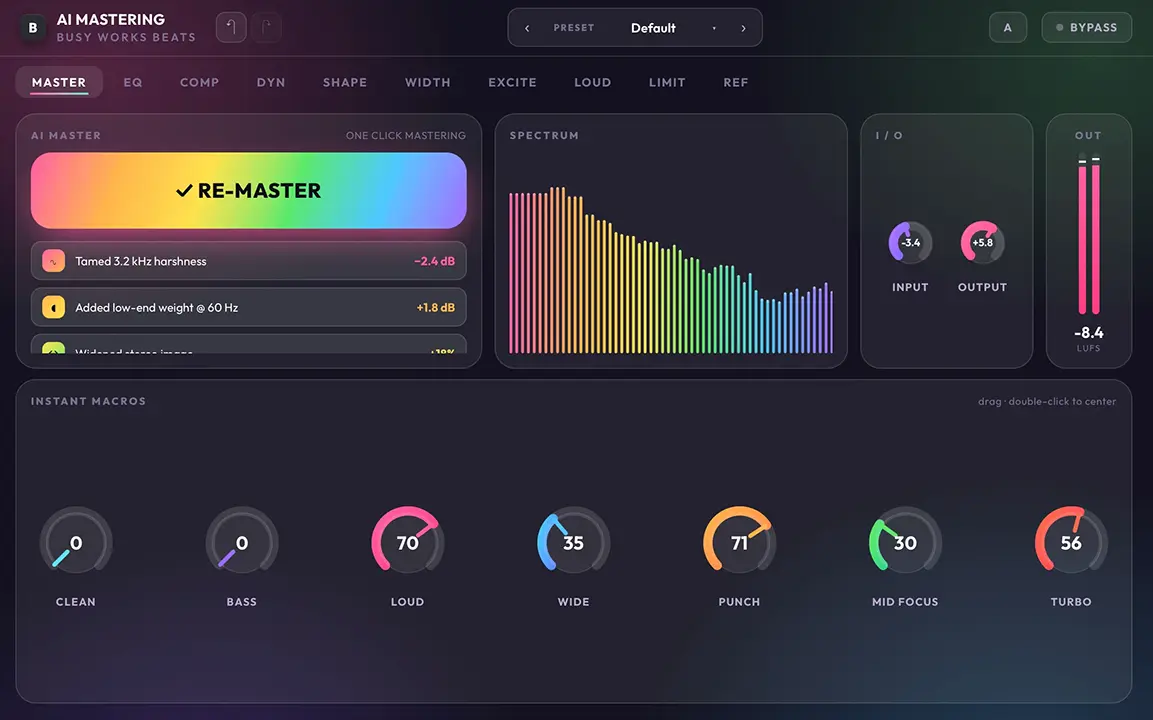
AI Mastering 8 is an automated mastering plugin that runs an analysis-driven processing chain — compression, multiband EQ, limiting, soft clipping, harmonic saturation, and stereo widening — from a single AI Master button press, with Auto Gain Stage setting the input level before the chain fires. Five macro controls labeled Clean, Bass, Loud, Wide, and Dynamics shape the output across the full chain without exposing individual plugin parameters. A global Amount knob blends between the raw input and the fully processed output from 0 to 100%. New in v8: Turbo and Mid Focus loudness modes, a dedicated Dynamics tab, Auto Clean processing, and an updated Analog mode. It answers the query: how do I get a loud, polished master on a hip-hop or trap beat without building or managing an individual mastering chain.
Key Takeaway
Bedroom producers who bounce beats for licensing, YouTube content, or direct-to-streaming releases — and who need a finished-sounding master faster than a manual chain allows — are the session context AI Mastering 8 is built for. The AI Master button and Amount blend eliminate the need to understand the individual processing stages, displacing the learn-a-mastering-chain step entirely. The automated chain is calibrated for hip-hop and trap loudness targets; classical, acoustic, jazz, or orchestral content sits outside the tonal and dynamic range the processing is designed around. Engineers who need full parameter transparency, export loudness compliance to specific delivery specs, or stems-based mastering control will not find that architecture here.
Auto Gain Stage and the AI Master Button
Pressing AI Master now triggers Auto Gain Stage before the processing chain fires — it analyzes the input level and sets the gain to an optimal point for the plugin’s internal chain, removing the manual input calibration step that caused inconsistent results in prior versions. This matters because the limiters, soft clipper, and saturation stages all respond differently at different input levels; arriving at them at a consistent level makes the automated output predictable across different beats with different peak levels. The underlying algorithm changed in v8, though the specific processing architecture is not disclosed in the product documentation.
Auto Gain Stage operates as a one-shot analysis triggered at button press, not as a continuous adaptive level control. A beat with significant dynamic range changes after the AI Master button is pressed — a drop section that’s significantly quieter than the verse, for example — won’t receive continuous level correction as playback continues.
Five Macro Controls and Amount Blending
The five macro controls — Clean, Bass, Loud, Wide, and Dynamics — each drive multiple processing stages simultaneously without exposing the underlying parameters. Clean targets resonances, harshness, and noise-like artifacts; Bass boosts and shapes low-frequency content; Loud drives the limiter and soft clipper harder; Wide increases stereo separation; Dynamics adjusts the compression behavior and transient character through the new dedicated tab. Each macro is an abstraction layer — turning up Loud doesn’t expose a threshold or ceiling value, it scales a set of limiter and soft clipper parameters that remain invisible.
The global Amount knob blends between the unprocessed input and the full plugin output at the current macro settings. At 50%, the output is an equal mix of dry and processed signal — which functions as parallel mastering, letting some of the original transient and dynamic character survive through the processed version. Amount provides the most direct control over how aggressively the mastering chain affects the source without touching the individual macros.
Custom parameter adjustment is available beyond the macros — the product page confirms access to individual compressor, limiter, and harmonics controls as custom tweaks. The depth of this parameter access is not fully documented in available sources; the extent to which individual processing stages can be overridden versus simply nudged around the macro settings is not confirmed.
Turbo, Mid Focus, and Loudness Architecture
Turbo and Mid Focus are two new loudness modes added in v8 that operate above the standard Loud macro setting. Turbo increases overall loudness by pushing the limiting and soft clipping stages harder than the Loud macro alone achieves; Mid Focus adds presence and forward character to the midrange during loudness processing, which affects how the master competes in the frequency range where vocals and snares sit on modern hip-hop and trap releases. Both are toggle modes rather than continuous controls.
The built-in limiter and soft clipper work in combination — soft clipping rounds transient peaks before the hard limiter sees them, which reduces the brickwall limiting artifacts that appear when transients hit a hard ceiling directly. This combination is the standard architecture for achieving high perceived loudness without audible distortion on heavily compressed music, and it is the same approach used in dedicated loudness maximizers at significantly higher price points.
The Analog mode in v8 is described as more analog and deeper than prior versions, adding harmonic saturation and warmth to the processing chain. The specific saturation algorithm or circuit topology is not disclosed.
Auto Clean and the Dynamics Tab
Auto Clean processes the input for audio problems — the product describes it as cleaning up bad audio, which in the context of a hip-hop and trap mastering tool covers resonant frequencies, inter-sample distortion from a noisy mix, and harshness in the upper midrange that becomes more prominent after limiting. Auto Clean fires as part of the AI Master processing pass rather than as a standalone diagnostic tool, which means it applies corrections that can’t be auditioned independently before the full mastering chain runs.
The Dynamics tab is a new addition in v8, providing dedicated control over the compression behavior beyond what the Dynamics macro offers. The specific parameters inside the tab are not documented in detail in publicly available sources; the tab appears to expose compressor ratio, attack, release, or similar controls for producers who need to override the automated dynamic behavior on sources with unusual transient characteristics. Beats with extreme low-end dynamics — 808s with long sustain tails, layered kicks that push the compressor in ways the automation doesn’t handle cleanly — are the primary target for manual Dynamics tab adjustment.
No LUFS Targeting, No Stem Input
AI Mastering 8 doesn’t expose a loudness target in LUFS, an integrated loudness meter, or a delivery-spec compliance display. Producers who need to hit a specific LUFS ceiling for Spotify, Apple Music, or YouTube normalization — which peaks at -14 LUFS integrated for most platforms — will need an external loudness meter to verify the output after processing. The plugin is built for competitive loudness in the hip-hop and trap market rather than platform-specific loudness compliance.
The plugin accepts a stereo mixdown as input — it is a stereo mastering insert, not a stem processor. Separate compression, limiting, and EQ decisions per stem (vocals up, kick down, reverb tail managed independently) require that work to be done before the mixdown reaches AI Mastering 8. The five macros operate on the full stereo sum with no stem separation or mid/side switching exposed at the macro level.
Workflow is designed for FL Studio and similarly structured beat-maker environments; the product page specifically calls out FL Studio as the primary DAW context, though VST3 and AU compatibility covers Logic Pro, Ableton Live, Reaper, Studio One, and Cubase. Producers whose session architecture involves complex routing, printed stems, or mix-bus parallel processing chains may find the single-insert, Amount-blend approach limiting compared to a full mastering chain with discrete processors.
FAQs
-
Does AI Mastering 8 target a specific loudness level in LUFS?
The plugin does not expose a LUFS target or integrated loudness meter — it drives the chain toward competitive loudness for hip-hop and trap without a user-configurable delivery ceiling. Producers delivering to streaming platforms that normalize to -14 LUFS integrated need to verify the output with an external loudness meter after processing. The Loud macro and Turbo mode push the limiter and soft clipper without reference to a specific platform specification.
-
What does the Amount knob do that the individual macros don’t?
Amount blends between the unprocessed dry signal and the fully processed output at the current macro settings, functioning as a parallel mastering control. At 100%, only the processed signal passes; at 50%, the output is equal parts dry and processed, preserving more of the original transient character and dynamic range alongside the processed version. The individual macros shape the character of the processed signal; Amount controls how much of that processing reaches the output.
-
Can AI Mastering 8 be used on individual tracks or only on a stereo mixdown?
The plugin is a stereo insert that processes a full stereo sum — it is designed as a final-stage mastering processor on the master bus or a mixdown bounce. Per-track mastering decisions such as compressing the kick independently from the vocal, managing individual stem dynamics, or applying different limiting to different frequency ranges require that work to happen in the mix before the stereo sum reaches AI Mastering 8.
-
What is the Dynamics tab and how does it differ from the Dynamics macro?
The Dynamics macro is one of the five abstraction-layer controls that scales compression and transient behavior as part of the overall macro system. The Dynamics tab, new in v8, provides deeper access to the compression stage — the specific parameters inside it are not fully documented in the product page, but the tab appears to allow manual override of the automated compression behavior for beats where the AI Master algorithm doesn’t handle the source dynamics optimally. The macro sets the general behavior; the tab offers correction beyond it.
-
Does Auto Clean function as a standalone tool or only as part of the AI Master chain?
Auto Clean is part of the AI Master processing pass and fires as part of the automated chain rather than as a separately auditioned diagnostic or correction stage. Engineers who want to hear the cleaning stage in isolation before committing to the full mastering pass cannot preview it independently from the other processing. The type of cleaning applied — resonance reduction, harshness correction, inter-sample distortion management — is not individually documented in the product’s available specifications.
Busy Works Beats AI Mastering 8
AI Mastering 8 is an automated mastering plugin that runs an analysis-driven processing chain — compression, multiband EQ, limiting, soft clipping, harmonic saturation, and stereo widening — from a single AI Master button press, with Auto Gain Stage setting the input level before the chain fires. Five macro controls labeled Clean, Bass, Loud, Wide, and Dynamics shape the output across the full chain without exposing individual plugin parameters. A global Amount knob blends between the raw input and the fully processed output from 0 to 100%. New in v8: Turbo and Mid Focus loudness modes, a dedicated Dynamics tab, Auto Clean processing, and an updated Analog mode. It answers the query: how do I get a loud, polished master on a hip-hop or trap beat without building or managing an individual mastering chain.
Price: 127
Price Currency: USD
Operating System: macOS 10.13
Application Category: Multimedia
3.6