


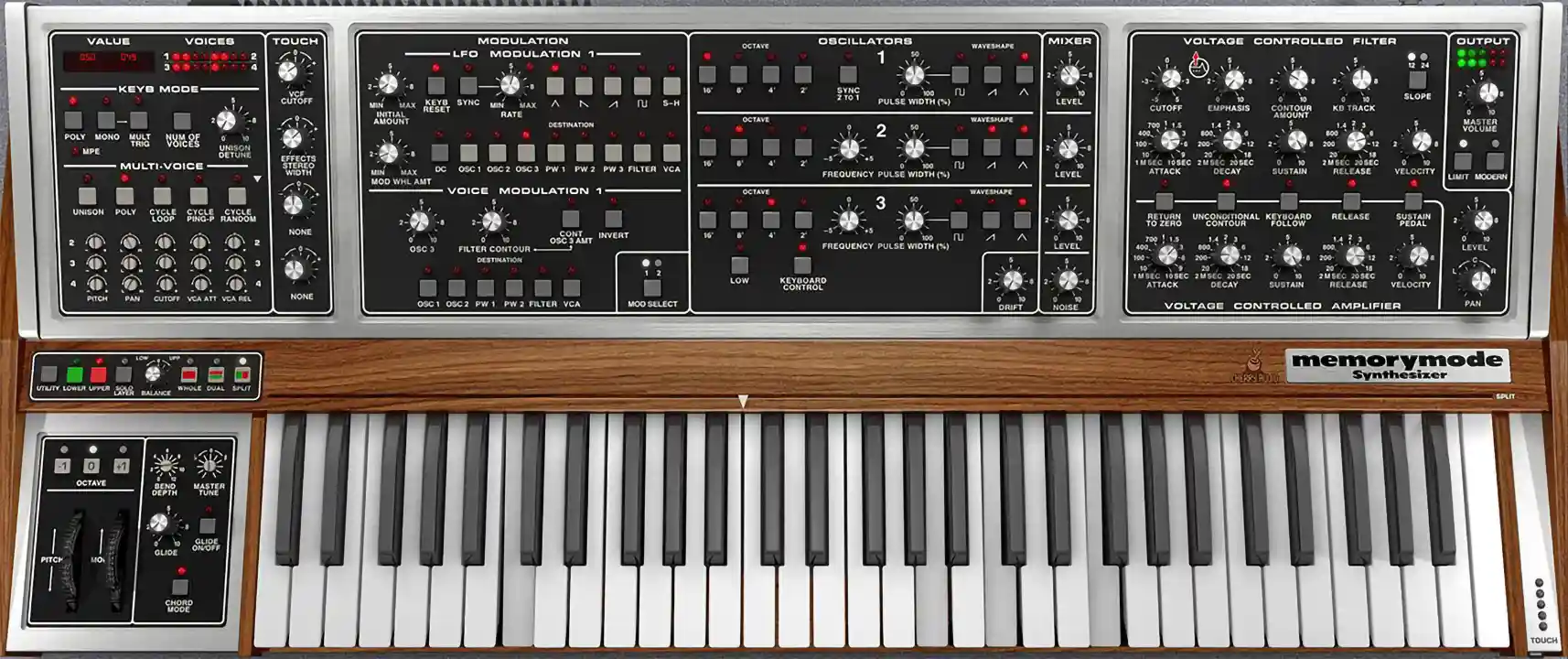
- Product: Memorymode 2
- Developer: Cherry Audio
- Version: 1.0.9.75
- Format: Standalone, VST, VST3, AAX
- Requirements: Windows 10 or later
- Source: cherryaudio.com/products/memorymode-v2
Cherry Audio has rebuilt Memorymode from the ground up. The result, Memorymode 2, arrives just over five years after the original — and it’s more than a facelift. Cherry Audio has brought the instrument in line with the rest of its product range in terms of capabilities and features, and used its expanded toolkit of analytical and measuring tools to get the sound engine even closer to an original vintage Minimoog. Expect functional changes alongside real improvements to the sound engine itself.
What’s New in Memorymode 2?
Interface
The original Memorymode shipped with a front-panel-only view. Memorymode 2 gets the full treatment: a keyboard view now standard across Cherry Audio’s lineup, sitting alongside performance controls on the left, plus separate motion and effects views in the bottom section. A hide-extras button lets you drop the keyboard and expand the front panel to fill the space if that’s all you want to see.
The core synth engine panels — modulation, oscillator, mixer, filter, outputs — are largely unchanged, aside from updated, more three-dimensional graphics and a handful of new controls scattered throughout.
Effects
Memorymode 1’s effects were hardwired: phaser, ensemble, echo, and reverb, always in that fixed signal path. Memorymode 2 replaces this with a five-slot, fully swappable effects bus — the flexible effects architecture familiar from Cherry Audio’s recent releases — with a wide range of effect types to choose from, including a brand new wide phaser effect.
Multitimbral Layers
The original Memorymode was monotimbral, with a single synth engine inside. Memorymode 2 adds two distinct synth engines and full layer support. Switching from single to dual layer mode reveals a new set of controls, including a solo-layer button and tasteful LED indicators — green for the lower layer, red for the upper. Each layer can carry its own stereo placement, opening up rich stereo imaging across a patch.
Voicing, Play Modes, and Multivoice
The voicing and play-mode section was already comprehensive in the original; Memorymode 2 expands it further. Synths can be played polyphonically across six modes (cyclic, cyclic with memory, reset to voice one, reset with memory, and more) or monophonically across three mono modes and three unison mono modes, all detailed in the user guide.
The standout addition is the multivoice section — Cherry Audio’s take on virtual poly-chaining. Engaging multivoice effectively layers up to four instances of the synth together, with independent control over each voice’s pitch, pan spread, filter cutoff, and envelope attack/release. Voices can be tuned subtly apart or dramatically detuned, spread across the stereo field, and combined with the arpeggiator for evolving, sequence-like textures from a single held note.
Motion View: Arpeggiator and Sequencer
The motion view houses the arpeggiator and sequencer. The arpeggiator carries over from Memorymode 1 but has been enhanced with new features including a chance control and a leap mode, bringing it up to date with Cherry Audio’s latest arpeggiator functionality.
The sequencer is the deeper addition. Alongside note sequencing, it can sequence modulation via the touch animator section — four independent lanes, each capable of animating any sound parameter via poly or mono aftertouch. Tracks can be built manually by dragging step values, or generated instantly from a library of rhythm templates. Each lane’s destination is chosen from a full menu of modulation targets, from filter contour amount to resonance to cutoff, making it possible to animate a static patch into something constantly moving.
Output Section
The output section keeps the familiar limiter and adds a new “modern” button — a fixed EQ smile applied at the very end of the signal chain, after all effects. It lifts the low end and adds air up top, giving patches a more contemporary low-and-high boosted character. It’s subtle, patch-dependent, and worth auditioning rather than leaving on by default.
Emphasis Compensation
A new emphasis compensation button addresses a known trait of the classic transistor ladder filter: pushing up resonance causes an overall drop in volume. With compensation engaged, that volume loss is corrected, giving the option to stay true to the original Minimoog-style behavior or diverge from it for a more consistent output level as resonance is pushed.
Compatibility
Installing Memorymode 2 does not overwrite the original Memorymode or its presets — both instruments and their libraries run side by side. Presets can be moved across via a simple drag-and-drop operation, detailed in the user guide. Because the sound engine itself has been rebuilt for accuracy, imported presets may sound slightly different and are worth a quick review and retweak after the move.
