


- Product: Syncourse
- Developer: Ghost Note Audio
- Version: 1.2.6
- Format: VST3/AU
- Requirements: Windows 10 or later, macOS 10.15 or later
- Source: ghostnoteaudio.uk/products/syncourse
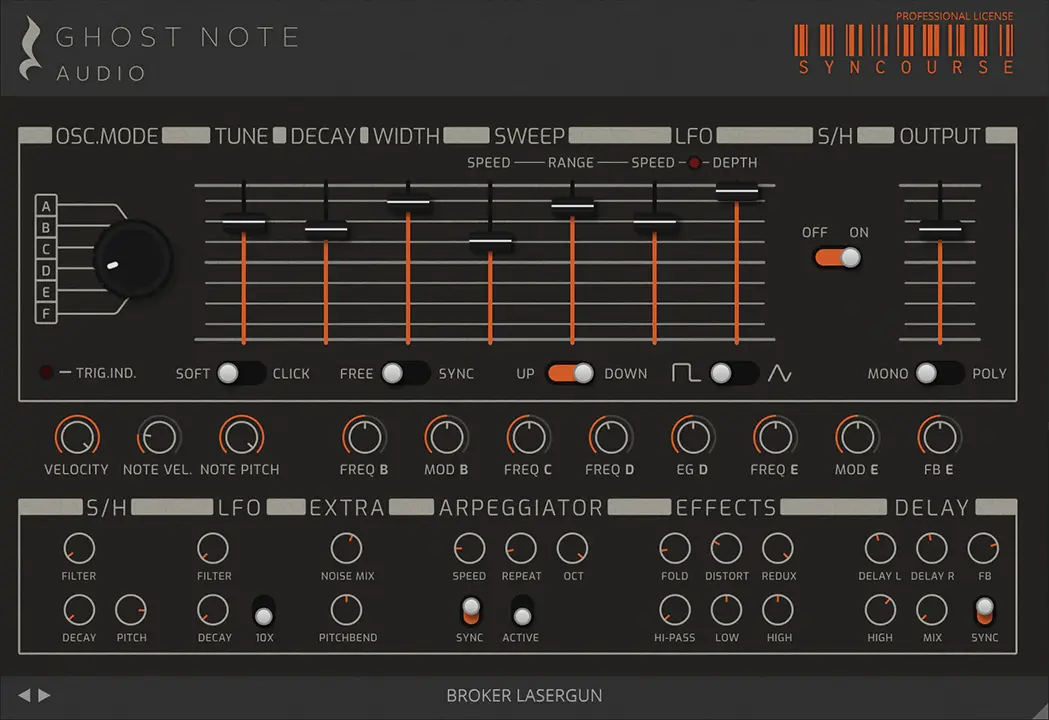
Syncourse is a percussion synthesizer plug-in modeling the six sound-generation modes of the Pearl Syncussion SY-1, an analog electronic drum module, with fader throw and response curve calibrated to match the original hardware. Where the SY-1 stayed analog, Syncourse runs a sinusoid wavefolder, clipping distortion, and samplerate reduction inline in the same signal path, plus a tempo-synced arpeggiator and stereo delay. The differentiator is leaving digital artifacts fully audible on an analog drum-synth core rather than smoothing them away — the query it answers is a harsh, digitally-degraded percussion synth for techno and industrial production.
Key Takeaway
Syncourse activates when a session needs a percussive hit or kick built from a synthesis engine rather than layered from samples. It displaces a hardware Syncussion unit or a clean sample-based drum synth reaching for transient control. The plugin ships as VST and AU only, with no AAX build for Pro Tools sessions. Producers building melodic or tonal percussion outside techno and industrial pull less from its three destructive effects.
Calibrated to the Original Throw
Syncourse implements all six modes of the Pearl Syncussion SY-1 — A through F — each mode generating a different percussive waveform algorithm behind the same control panel. Modes B, C, D, and E expose additional internal parameters the original hardware never surfaced, reaching into the algorithm rather than just the front-panel mix knobs.
Every fader is calibrated to match the throw and curve of the SY-1’s originals, so a sweep that took a quarter-turn on the hardware takes the same relative fader travel here. Digital artifacts run through the signal at full strength instead of being filtered out, audible as aliasing and quantization noise layered onto what would otherwise pass as a clean analog-modeled hit.
The six-mode structure is fixed to the source hardware’s architecture — there’s no seventh custom mode or open oscillator section outside what the SY-1 defined. Producers recreating a specific vintage electronic-drum sound get direct use from the mode-accurate calibration; producers wanting a fully open percussion-synthesis engine look elsewhere for an oscillator section not bound to 1970s hardware behavior.
Wavefolder Into Clipper Into Bitcrush
The sinusoid wavefolder feeds a percussive hit back through a folding sine curve, adding harmonic content that increases with input level rather than a fixed distortion amount. Clipping distortion sits after the wavefolder in the chain, hard-clipping the folded signal for a second, harsher stage of harmonic generation.
Samplerate reduction runs last, dropping the effective sample rate to introduce aliasing artifacts directly into the audio rather than modeling them, audible as a gritty, bit-crushed edge on the tail of a hit. Stacking all three in sequence turns a clean synthesized kick into a distorted, speaker-shaking one without leaving the plug-in for an external saturation or bitcrush unit.
None of the three effects carry a dry/wet blend independent of the others — driving one stage hard pushes the signal into the next stage at the same intensity, with no way to isolate wavefolding from clipping. Producers building harsh techno and industrial kicks get full use from the chain; producers wanting a subtle, controlled saturation stage reach for a dedicated saturation plug-in with independent staging instead.
One Voice, Retriggered on Tempo
The arpeggiator runs with tempo sync, retriggering the percussion engine on a rhythmic pattern rather than requiring a MIDI pattern drawn note by note. Expanded modulation routing beyond the SY-1’s fixed envelope reaches into more of the six modes’ internal parameters than the hardware ever exposed.
The arpeggiator drives the same percussive voice repeatedly rather than cycling through a chord or scale, functioning as a rhythmic gate on one sound instead of a melodic sequencer. Producers programming a repeating hi-hat or shaker pattern from a single Syncourse instance get direct use from tempo sync; producers needing pitched, sequenced percussion across a scale reach for a separate sequencer plug-in upstream.
Tone Shaped After the Damage
Low-shelf, high-shelf, and high-pass tone controls sit after the destructive effects chain, shaping the harmonic mess the wavefolder, clipper, and samplerate reducer generate rather than a clean source. Pulling the high-shelf down tames the harshest aliasing artifacts without undoing the distortion stage underneath it.
The stereo delay runs with tempo sync, widening a single percussive hit into a rhythmic, stereo-spread pattern without routing to a separate delay plug-in. Feedback pushed high on a heavily distorted hit compounds the grit with each repeat rather than producing a clean decaying echo.
The tone controls shape after distortion, not before it — there’s no pre-distortion EQ stage to tame a harsh source going into the wavefolder. Producers finishing a percussive sound entirely inside one plug-in instance get full use from the post-effects chain; producers wanting to shape tone before hitting the destructive stages route an EQ ahead of Syncourse instead.
When the Pattern Needs Pitched Steps
The arpeggiator retriggers Mode A through F at one fixed pitch per instance; stepping through a scale means stacking separate Syncourse instances tuned individually, one per note.
FAQs
-
Does Syncourse require a license to run, or does it work in demo mode?
Syncourse installs and runs without a license key, operating in a full-featured demo mode with every mode, effect, and control active. A short burst of noise generates intermittently during demo playback as the only functional restriction. Purchasing the £38 license removes the noise burst; no additional features unlock beyond that removal.
-
What plug-in formats does Syncourse support?
Syncourse installs as VST on Windows and macOS, and as Audio Unit on macOS only. There is no AAX build, so Pro Tools sessions can’t load it natively without a third-party wrapper. Both platforms require a 64-bit processor, with AVX support required on the PC side.
-
How closely does Syncourse match the original Pearl Syncussion SY-1 hardware?
All six of the SY-1’s sound-generation modes are implemented, with faders calibrated to reproduce the original’s throw and response curve. Modes B, C, D, and E expose internal parameters the hardware never surfaced on its front panel, going past a direct port. Digital artifacts from the emulation stay in the signal rather than being filtered out, which the analog original never produced.
-
Can Syncourse produce clean, undistorted percussion, or is it built specifically for a harsh sound?
The sinusoid wavefolder, clipping distortion, and samplerate reduction sit inline in the signal path and can be turned down, not removed from the chain. Even at minimal settings the six underlying modes carry over the SY-1’s original percussive character rather than a fully neutral tone. Producers wanting a pristine, artifact-free percussion synth get more predictable results from a plug-in built around that goal instead.
-
Does the arpeggiator let Syncourse play melodic or pitched percussion sequences?
The arpeggiator retriggers the active mode’s voice on a tempo-synced rhythmic pattern rather than stepping through a set of pitches. One Syncourse instance outputs one fixed pitch per pattern regardless of how many arpeggiator steps are programmed. Pitched, sequenced percussion across a scale requires stacking multiple instances, each tuned to a different note.

Ghost Note Audio Syncourse
Syncourse is a percussion synthesizer plug-in modeling the six sound-generation modes of the Pearl Syncussion SY-1, an analog electronic drum module, with fader throw and response curve calibrated to match the original hardware. Where the SY-1 stayed analog, Syncourse runs a sinusoid wavefolder, clipping distortion, and samplerate reduction inline in the same signal path, plus a tempo-synced arpeggiator and stereo delay. The differentiator is leaving digital artifacts fully audible on an analog drum-synth core rather than smoothing them away — the query it answers is a harsh, digitally-degraded percussion synth for techno and industrial production.
Price: 38
Price Currency: EUR
Operating System: Windows 10, macOS 10.15
Application Category: Multimedia
4.2