


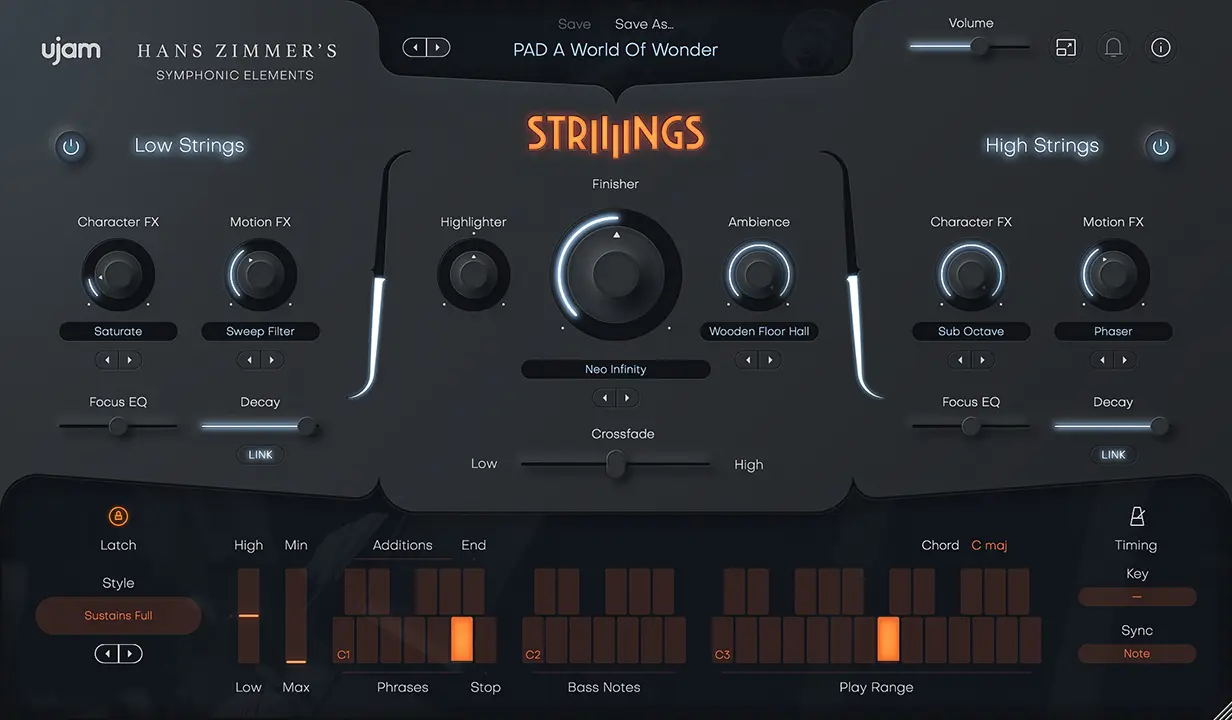
- Product: Hans Zimmer’s Symphonic Elements STRIIIINGS
- Developer: UJAM
- Version: 1.3.1
- Format: VST, VST3, AAX
- Requirements: Windows 10 or later
- Source: ujam.com/symphonic-elements/striiiings
I copied the same MIDI part onto three tracks — STRIIIINGS, CHOOIR, and BRAAASS loaded side by side — and all three played immediately, with only the chosen preset doing the differentiation. That’s the workflow the Symphonic Elements series is built around. STRIIIINGS contributes Hans Zimmer’s personal library string recordings to that system: Low Strings and High Strings split into two independent processing layers, each with its own Character and Motion FX chain, 60 Styles, more than 200 presets, and an integrated Finisher stage carrying the full signal through to output.
Key Takeaway
STRIIIINGS’ defining workflow move is MIDI part compatibility across the tonal SE plugins — one MIDI part copied to STRIIIINGS, CHOOIR, and BRAAASS plays all three at once, with only preset selection doing the differentiation. The ecosystem makes that advantage real. Buying STRIIIINGS alone at $249 is paying for a feature that only exists when CHOOIR and BRAAASS are already running alongside it.
Low and High Sections Running Independent Chains
STRIIIINGS splits its orchestra into Low Strings (basses and celli) and High Strings (violins and violas), with a Crossfade control blending the two rather than locking them into a fixed orchestral balance. Each section carries its own Character and Motion FX — the two registers aren’t EQ variants of the same signal, they’re separately shaped through the same processing architecture with independent settings.
The practical consequence is that the low register can be pushed into a Clavidrone-type atmosphere — deep, tonally ambiguous, designed for dread — while the high strings remain cleaner or fully faded, rather than forcing both into the same Character state. On a dark cue, that separation is the difference between a texture that feels layered and one that just feels loud.
One MIDI Part, Three Instruments
The MIDI compatibility across STRIIIINGS, CHOOIR, and BRAAASS is what Hans Zimmer meant when he described the Symphonic Elements series as Legos — starting points that build on each other rather than standalone answers. I’ve run a single passage of minor chords across all three tonal SE plugins from the same MIDI part. They lock together immediately. The low choir adds depth underneath, the strings carry the body of the texture, and the brass frames the harmonic weight on top, with none of them requiring separate part programming.
That compatibility covers the tonal SE plugins specifically. PERRCS and DRUMS run their own shared architecture separately. A producer building a dark cue populates the string, choir, and brass layers from one written part and uses preset selection to differentiate them — a composing workflow that collapses what would otherwise be three separate programming passes into one.
The Inharmonic Effect and What It Does to a Held Note
The Character FX section carries an Inharmonic control that introduces subtle instability to the string partials — not vibrato, not chorus, but a slightly detuned inharmonic relationship that makes held notes feel uneasy rather than static. I automated it very gently across four bars on an “Underwater Angels”-type patch: barely present at the note’s attack, rising past audible-but-not-obvious by the halfway point. The effect creates the kind of unease that’s technically present but hard to consciously locate, which is exactly the register a quiet suspense scene needs.
Motion FX adds time-domain animation on top — rhythmic modulation, animated texture — running independently from whatever Character FX is already doing. Together they push STRIIIINGS past static layered samples into material that breathes over a held chord without requiring additional automation lanes to generate the movement.
60 Styles and 200+ Presets as Starting Points
The 60 Styles define how STRIIIINGS performs — the phrase patterns, articulation approaches, and rhythmic feel the section plays when notes come in. The more than 200 presets define the tonal character and sound design state of the two string sections at that moment. They’re separate decisions: the same Style played through a dark, fear-inducing preset sounds substantially different from the same Style through a warmer, more neutral one, and mixing them across a session produces differentiation without requiring additional programming.
Zimmer framed it plainly — these are elements to tear apart and reassemble, not finished answers. The Styles back that up: a dark suspense cue, a cinematic swell, and an arpeggiated build each have a workable starting point without scrolling through material designed for a completely different register. The preset palette is weighted heavily toward dark and dramatic territory, which is a design choice reflecting the library’s origin, not an editorial gap.
When STRIIIINGS Is the Wrong Tool
STRIIIINGS doesn’t expose per-voice articulation as programmable controls. Bowing direction, sul ponticello, col legno, and pizzicato aren’t selectable per note — you work at the Style and preset level rather than the individual instrument level. A composer who writes their own string parts note by note from blank MIDI, choosing each articulation manually, is working against the plugin’s design rather than with it.
The trial linked at the top of this review was sourced from UJAM’s own public trials page, where STRIIIINGS is available as a free download directly from ujam.com — the same source as the full version. If the MIDI ecosystem workflow and the Zimmer library recordings are enough to know this fits the session, the full version is at UJAM’s store — currently $169.32 on sale from $249.
Pros & Cons
Pros:
- MIDI part compatibility across all three tonal SE plugins lets one written part power strings, choir, and brass simultaneously — a workflow efficiency with no real equivalent in competing string libraries.
- Low and High string sections run independent sound design engines, meaning basses and celli can be driven into a completely different Character FX state than the violins without affecting each other.
- The Inharmonic Character effect creates genuine unease on held notes — subtle enough to sit below conscious detection, specific enough to do real emotional work on a dark or suspense cue.
- Recordings from Zimmer’s personal library bring a level of provenance that distinguishes this from the crowded field of generic Hollywood-strings plugins.
Cons:
- Stylistically narrow — the preset library leans heavily toward dark, cinematic, and atmospheric territory; light chamber textures, baroque writing, or pastoral string playing are genuinely outside this palette.
- The MIDI compatibility advantage requires CHOOIR and BRAAASS in the session; as a standalone purchase at $249, STRIIIINGS is a premium string plugin without its most distinctive feature.
- No per-voice articulation editing — bowing direction, sul ponticello, col legno, and individual articulation programming aren’t accessible as discrete controls.
- 4.7GB install is not trivial, and UJAM recommends SSD storage for the sample content on external drives to prevent dropouts.
Editor’s Note: The MIDI copy workflow is what I keep returning to. Running the same passage through STRIIIINGS, CHOOIR, and BRAAASS simultaneously and differentiating them purely through preset selection produces a layered orchestral texture in a couple of minutes that would take significantly longer across three incompatible libraries. That’s the argument for the ecosystem — and honestly, it’s where Zimmer’s “Lego” framing stops being marketing and starts being an accurate description of the composing process.
Rating: 4.1 / 5
- Sonic authenticity — 4.6/5: sourced from Hans Zimmer’s personal multi-million-dollar library with world-class musicians, microphones, and hall — a provenance that produces a string weight and texture that generic cinematic strings rarely match.
- MIDI ecosystem integration — 4.5/5: MIDI part compatibility across STRIIIINGS, CHOOIR, and BRAAASS turns one written part into a full orchestral layer in seconds, with no equivalent in competing libraries.
- Preset character — 4.1/5: more than 200 presets are strong within a deliberately dark and cinematic palette, though that palette is narrow enough to constrain producers working outside the dramatic register.
- Sound shaping depth — 3.8/5: Character FX, Motion FX, and integrated Finisher give meaningful real-time sculpting, but the plugin stops well short of deep synthesis or per-voice articulation control.
- Standalone value — 3.4/5: $249 for strings alone is a significant purchase; the MIDI compatibility advantage — STRIIIINGS’ most distinctive feature — only fully materializes when CHOOIR and BRAAASS are also loaded.
FAQs
-
Does STRIIIINGS work as a standalone instrument, or does it require the full Symphonic Elements suite?
STRIIIINGS runs as a standalone instrument and produces full, usable string arrangements without any other Symphonic Elements plugin loaded. The MIDI part compatibility feature — copying one MIDI part across STRIIIINGS, CHOOIR, and BRAAASS and having all three play together immediately — only functions when those other tonal SE plugins are also present. Standalone, STRIIIINGS is a strong cinematic string instrument; inside the full ecosystem, it becomes a building block in a compatible orchestral layer.
-
Where does the trial version on this page come from?
The trial linked at the top of this review was sourced from UJAM’s own public trials page at ujam.com/more/trials, where STRIIIINGS and the rest of the Symphonic Elements series are available for direct download. UJAM hosts and distributes the trials through their own platform — the same source and activation system as the full paid version.
-
What’s the difference between Styles and presets in STRIIIINGS?
Styles determine how STRIIIINGS performs — the phrase patterns, rhythmic feel, and articulation approach the string section plays when notes come in. Presets determine the tonal character and sound design state of the Low and High string sections at that moment. They’re two separate decisions: the same Style played through a dark atmospheric preset sounds substantially different from the same Style through a warmer, more neutral one. Choosing a Style and choosing a preset are independent steps in building a sound.
-
Can STRIIIINGS produce light or pastoral string textures, or is the sound locked into a cinematic register?
The preset library and Styles are weighted toward dramatic, dark, and cinematic orchestral territory, reflecting both the Zimmer library’s character and the design intent of the plugin. Light chamber strings, pastoral textures, and baroque-adjacent writing are outside what the more than 200 presets are built to deliver. Character and Motion FX can push sounds toward warmer or more neutral territory, but the underlying source material remains a large-scale orchestral string section rather than a small ensemble.
-
What formats and systems does STRIIIINGS require?
STRIIIINGS runs as VST2, VST3, AAX, and AU2 — all 64-bit — on Windows 10 and 11, and macOS Mojave (10.14) through macOS Tahoe, with native Apple Silicon support and Rosetta compatibility on Intel Macs. Minimum requirements are 4GB of RAM and 4.7GB of disk space; UJAM recommends SSD storage for the sample content if installed on an external drive. Authorization runs through the UJAM App or directly inside the plugin with an email and password. NKS is supported, and the plugin works across all major DAWs including Ableton, Logic Pro, Pro Tools, FL Studio, Cubase, and Studio One.

Hans Zimmer's Symphonic Elements STRIIIINGS
STRIIIINGS scores 4.6/5 for sonic authenticity — sourced from Hans Zimmer's personal multi-million-dollar library with world-class musicians, microphones, and hall, producing a string weight and texture that generic cinematic strings rarely match. MIDI ecosystem integration lands at 4.5/5: MIDI part compatibility across STRIIIINGS, CHOOIR, and BRAAASS turns one written part into a full orchestral layer in seconds, with no equivalent in competing libraries. Preset character rates 4.1/5, with more than 200 presets strong within a deliberately dark and cinematic palette, though the narrowness of that palette constrains producers outside the dramatic register. Sound shaping depth scores 3.8/5 — Character FX, Motion FX, and integrated Finisher provide meaningful sculpting tools, but the plugin stops well short of deep synthesis or per-voice articulation control. Standalone value comes in at 3.4/5: $249 for strings alone is significant, and the MIDI compatibility advantage only fully materializes when CHOOIR and BRAAASS are also loaded in the session.
Price: 202.80
Price Currency: USD
Operating System: Windows 10
Application Category: Multimedia
4.1