


- Product: Articulate
- Publisher: Newfangled Audio
- Version: 1.1.4
- Format: VST2, VST3
- Requirements: Windows 10 or later
- Source: newfangledaudio.com/articulate
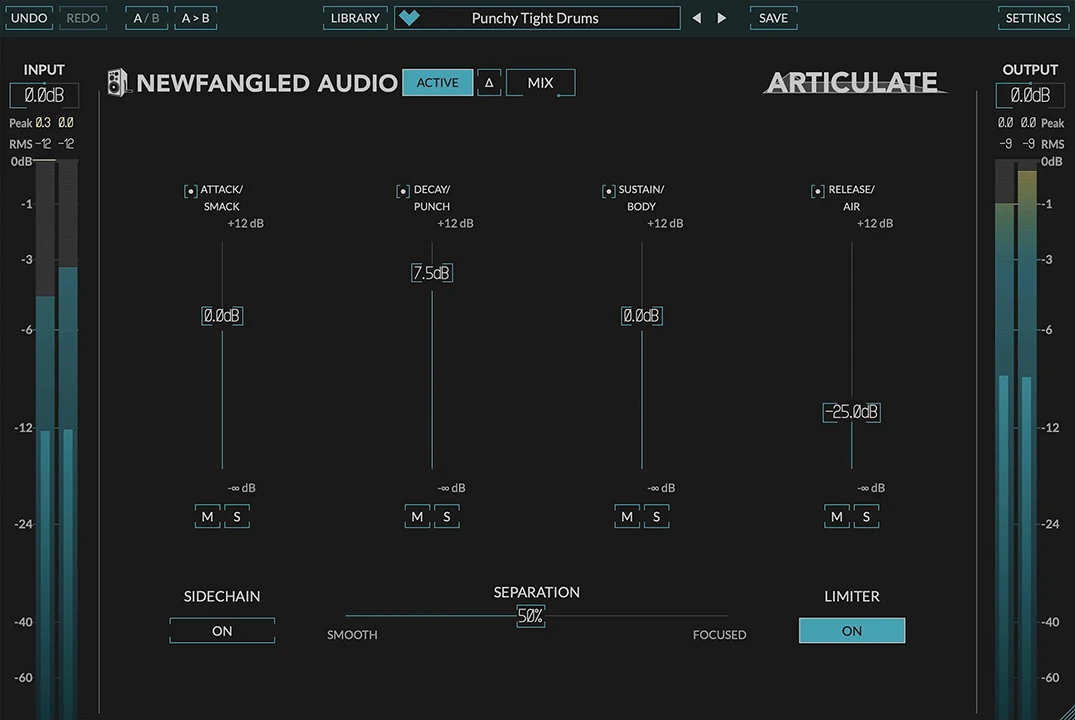
Articulate is an envelope-shaping plugin that splits any audio signal into four independently adjustable stages — Attack, Decay, Sustain, and Release — using a synthesizer-style ADSR model applied to recorded material rather than a single attack/sustain pair. It sits ahead of or instead of compression on individual tracks, reshaping how a sound’s energy unfolds over its first few hundred milliseconds without touching frequency content. Its differentiator is stage count: four independently soloable, mutable bands instead of the two-knob attack/sustain layout most transient shapers offer. For anyone searching for ADSR-style control over a recorded sound rather than a synthesized one, this is that control.
Key Takeaway
Activates when a sound’s shape needs surgical correction — a kick that won’t punch, a snare tail that won’t ring, a pick attack that’s too sharp — and a compressor would change the wrong thing along with the right one. Displaces or precedes compression on individual tracks rather than replacing bus-level glue. Doesn’t have per-stage routing to separate aux sends, so isolating one envelope stage for independent processing means duplicating tracks manually; engineers who only need a single attack/sustain knob can skip the four-stage layout.
Four-Stage Envelope Control and Soloing
Attack, Decay, Sustain, and Release each get an independent gain stage from +12dB to full mute, labeled Smack, Punch, Body, and Air respectively, so a kick drum’s initial transient can be pushed up while its sustain gets pulled down in the same pass. Each stage can be soloed or muted individually, which lets an engineer hear exactly which 50-millisecond slice of a sound is contributing the boxiness or the click before deciding what to do about it.
Soloing behaves as a single-select toggle rather than a multi-select group — choosing solo on one stage cancels whatever was soloed before it, so isolating two non-adjacent stages together (Attack and Release without Decay and Sustain) requires muting the unwanted stages by hand instead of soloing the wanted ones. This adds a few extra clicks to an isolation workflow that a checkbox-style solo group would have avoided.
Separation Control and Pumping at High Settings
The Separation control sets how sharply the four stages divide from each other, running from Smooth (more bleed between stages, fewer artifacts) to Focused (fast, sharp transitions with audible pumping at full setting). At low Separation, attack and decay boosts blend together more naturally; at high Separation, the same boosts produce more aggressive, percussive transitions between stages.
This means the same fader settings sound meaningfully different depending on where Separation sits, which turns it into a second axis of control rather than a fixed parameter to set once. On drum sources, pushing Separation toward Focused alongside raised Decay and Sustain faders produces a tightened, glued kit sound that several independent testers found worked best when the two controls were adjusted together rather than Separation left at a default.
Drum and Transient Source Performance
On individual drum mics, lowering Attack while keeping Decay moderate removes pick-style click and ring without the brittleness that aggressive attack-control settings introduce on other transient shapers; one independent test found this approach more transparent for taming an overly sharp kick or snare hit than a comparable EQ cut, since no phase shift gets introduced the way a filter would add one. Raising Sustain and Release on a snare brings out tail and “ping” without dragging up cymbal bleed captured on the same mic, which a straight gain boost on the whole track would do.
Bass and picked sources respond the same way: lowering Attack tames an overly plucky pick transient, and raising it reinforces a soft, under-articulate low end without needing an EQ boost that would also lift unwanted midrange. The same control logic that works for drums transfers directly because the plugin operates on envelope shape rather than frequency content, so the source material’s spectral balance stays untouched.
Sidechain Detection and Vocal Source Limits
The sidechain input lets one track’s envelope reshape another’s — ducking a bass line’s attack from a kick’s transient, or pulsing a pad in time with a drum hit — which moves the control point from the processed track itself to whatever rhythmic source is driving it. Independent testing found this reliable for rhythmic pulsing effects but reported audible clicking artifacts appearing in time with the trigger source on certain bass-ducking configurations, a limitation that surfaced specifically under sidechain use and not on the plugin’s direct, non-sidechained processing.
Vocal sources are the plugin’s weakest fit: independent testing found limited use cases on vocals generally, and a track recorded on a lower-quality microphone produced results that pointed toward dedicated audio-restoration tools rather than envelope reshaping. The four-stage logic that transforms drums and bass cleanly doesn’t carry the same advantage onto a source where the problem is tonal or noise-based rather than shaped by attack-decay-sustain-release timing.
Four Stages, No Aux Sends Between Them
Articulate gives Attack, Decay, Sustain, and Release each their own gain and solo control, but none of the four routes to a separate aux track for independent downstream processing. Sending just the Decay/Sustain/Release portion of a sound to its own reverb, the way one engineer worked around the limitation by duplicating tracks, still means building that signal path by hand.
FAQs
-
How is Articulate different from a standard attack/sustain transient shaper?
Articulate splits a signal into four independently adjustable stages — Attack, Decay, Sustain, and Release — rather than the two-control attack/sustain layout most transient shapers use. Each stage can be soloed or muted on its own, which exposes which specific slice of a sound’s envelope is causing a problem before any gain change is made. The tradeoff is a steeper initial learning curve than a two-knob design, though independent testers describe the controls as intuitive once the ADSR mapping clicks.
-
Can I solo more than one envelope stage at the same time?
Soloing one stage automatically cancels any other stage that was previously soloed, so only one stage can be soloed at once through the solo button itself. Hearing two non-adjacent stages together — Attack and Release without Decay and Sustain, for example — requires muting the unwanted stages manually rather than soloing the wanted ones. This adds steps to an isolation workflow compared to a checkbox-style multi-solo system.
-
Does raising Separation change the sound even if the four faders stay the same?
Yes — Separation controls how sharply the four envelope stages divide from each other, independent of where the Attack, Decay, Sustain, and Release faders are set. At low Separation the stages blend with more bleed and fewer artifacts; at high Separation the transitions become sharp enough to produce audible pumping. The same fader settings will sound different at different Separation values, so the two controls need to be tuned together rather than treated separately.
-
Is Articulate a good fit for vocal processing?
Independent testing found limited use cases on vocals compared to drums, bass, and guitar, where the envelope-based approach maps more directly onto the problem being solved. On a vocal track recorded with a lower-quality microphone, testing pointed toward dedicated restoration tools rather than envelope reshaping as the more effective fix. The four-stage model works best on sources where the issue is shaped by attack-decay-sustain-release timing rather than tonal quality or noise.
-
Does the sidechain mode work reliably for ducking one track with another?
Sidechain detection lets one track’s envelope reshape a second track’s level, commonly used to duck a bass line’s attack using a kick drum as the trigger. Independent testing found this effective for rhythmic pulsing effects but reported audible clicking artifacts in time with the trigger source on certain bass-ducking setups. Testing the specific source pairing before committing to a sidechain configuration in a mix avoids carrying an artifact through to a final bounce.

Newfangled Audio Articulate
Articulate is an envelope-shaping plugin that splits any audio signal into four independently adjustable stages — Attack, Decay, Sustain, and Release — using a synthesizer-style ADSR model applied to recorded material rather than a single attack/sustain pair. It sits ahead of or instead of compression on individual tracks, reshaping how a sound's energy unfolds over its first few hundred milliseconds without touching frequency content. Its differentiator is stage count: four independently soloable, mutable bands instead of the two-knob attack/sustain layout most transient shapers offer. For anyone searching for ADSR-style control over a recorded sound rather than a synthesized one, this is that control.
Price: 69
Price Currency: USD
Operating System: Windows 10
Application Category: Multimedia
4.4