


- Product: P44 Magnum
- Developer: Pulsar Modular
- Version: 1.1.2
- Format: VST3, AAX
- Requirements: Windows 10 or later
- Source: pulsarmodular.com/product/p44-magnum
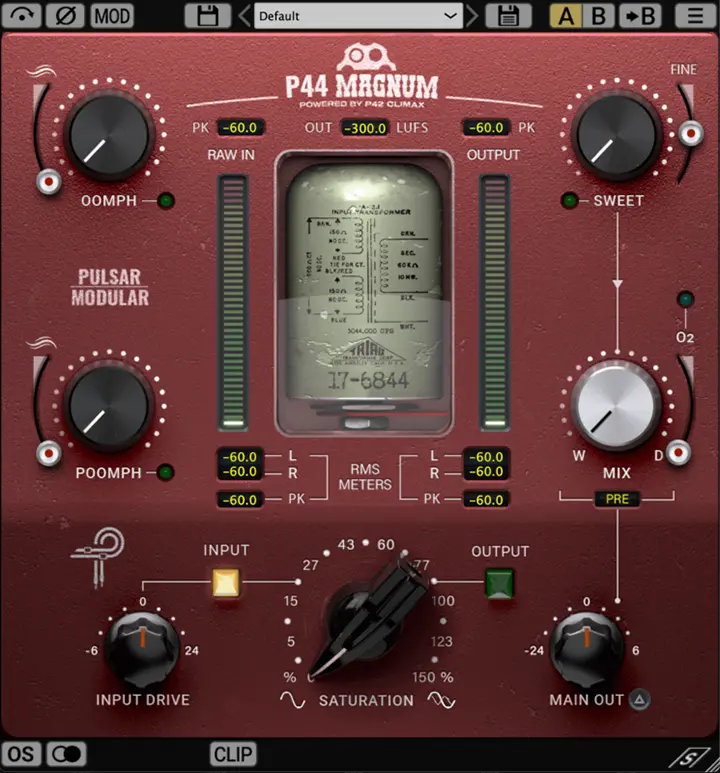
Pulsar Modular P44 Magnum is a saturation and clipping plugin built around the P42 Climax circuit, combining harmonic distortion, low-end enhancement, and peak control into a single processing stage. Designed for mix bus and drum processing, it focuses on aggressive weight, density, and loudness shaping rather than transparent saturation. It functions as a mix bus saturation plugin for pushing low-end impact and overall level without relying on complex multi-plugin chains.
Key Takeaway
P44 Magnum is about impact more than subtlety. It’s designed to add weight, density, and loudness quickly, especially in the low end, without building a complex chain of separate processors.
P42-derived saturation circuit forming the core tone
The plugin is built on the same saturation foundation as P42 Climax, but reworked into a more direct and streamlined processor.
The saturation is not neutral. It adds harmonic density and forward energy, particularly noticeable on drums, bass, and full mixes. Driving the input pushes the signal into thicker, more compressed territory, but without requiring multiple stages of processing.
It behaves like a central tone-shaping stage rather than a subtle enhancement layer.
Oomph and Poomph circuits reshaping low-end weight
Low-frequency control is handled through two dedicated circuits—Oomph and Poomph—designed specifically for shaping bass response.
These don’t act like standard EQ boosts. Instead, they change how the low end is perceived, adding weight and punch while preserving transient definition in updated versions.
On kick drums and bass-heavy material, this becomes one of the defining aspects of the plugin, often replacing the need for separate low-end processing tools.
Sweet high-shelf shaping balancing added density
The “Sweet” control introduces a custom high-shelf curve that compensates for the density added by saturation.
As low-end weight and harmonics increase, the high frequencies can lose clarity. This stage restores presence without becoming sharp or brittle.
It works less like corrective EQ and more like a balancing control that keeps the overall tone usable after heavy processing.
O2 harmonic excitation extending upper harmonic detail
An additional harmonic exciter stage enhances upper harmonics independently of the main saturation circuit.
This allows separation between thickness and brightness. Low-end weight can be increased while still introducing high-frequency detail through controlled excitation.
The result is a more flexible tonal range than a single saturation stage would typically allow.
Integrated clipper controlling peaks while increasing loudness
A built-in clipper sits at the end of the chain, designed to control peaks and increase perceived loudness.
Unlike traditional limiters, clipping here is part of the sound. It can tighten transients and push levels higher without introducing pumping artifacts.
With the addition of adjustable knee behavior in later versions, the transition into clipping can be softened or made more aggressive depending on the material.
Low CPU and zero-latency operation supporting real-time use
The plugin is designed to run with minimal CPU load and zero latency when the clipper is disabled.
This makes it usable across multiple tracks or in live processing situations without adding system overhead. It also encourages stacking instances rather than relying on a single heavy processor.
Saturation workflow centered on density, weight, and loudness
P44 Magnum combines multiple processing stages into a single interface, focusing on fast tonal results rather than detailed parameter control. Saturation, low-end shaping, excitation, and clipping all interact as part of one chain.
The limitation is precision. It’s not designed for surgical adjustments or transparent processing. In return, it delivers immediate impact, especially on low-end-driven material and mix buses where weight and loudness are priorities.
FAQs
-
What type of plugin is P44 Magnum?
It’s a saturation and enhancement plugin that combines harmonic processing, low-end shaping, and clipping into a single chain.
-
Is it suitable for mix bus processing?
Yes. It’s commonly used on buses and masters to add weight, cohesion, and loudness, especially in bass-heavy genres.
-
What do Oomph and Poomph do?
They shape the low end by enhancing perceived weight and punch rather than acting as traditional EQ boosts.
-
Does it replace a limiter?
Partially. The built-in clipper can control peaks and increase loudness, but it may still be paired with a limiter for final mastering stages.
-
Is it CPU intensive?
No. It’s designed for low CPU usage and can run with zero latency when the clipper is turned off.

Pulsar Modular P44 Magnum

Pulsar Modular P44 Magnum is a saturation and clipping plugin built around the P42 Climax circuit, combining harmonic distortion, low-end enhancement, and peak control into a single processing stage. Designed for mix bus and drum processing, it focuses on aggressive weight, density, and loudness shaping rather than transparent saturation. It functions as a mix bus saturation plugin for pushing low-end impact and overall level without relying on complex multi-plugin chains.
Price: 180
Price Currency: USD
Operating System: Windows 10
Application Category: Multimedia
4.5