


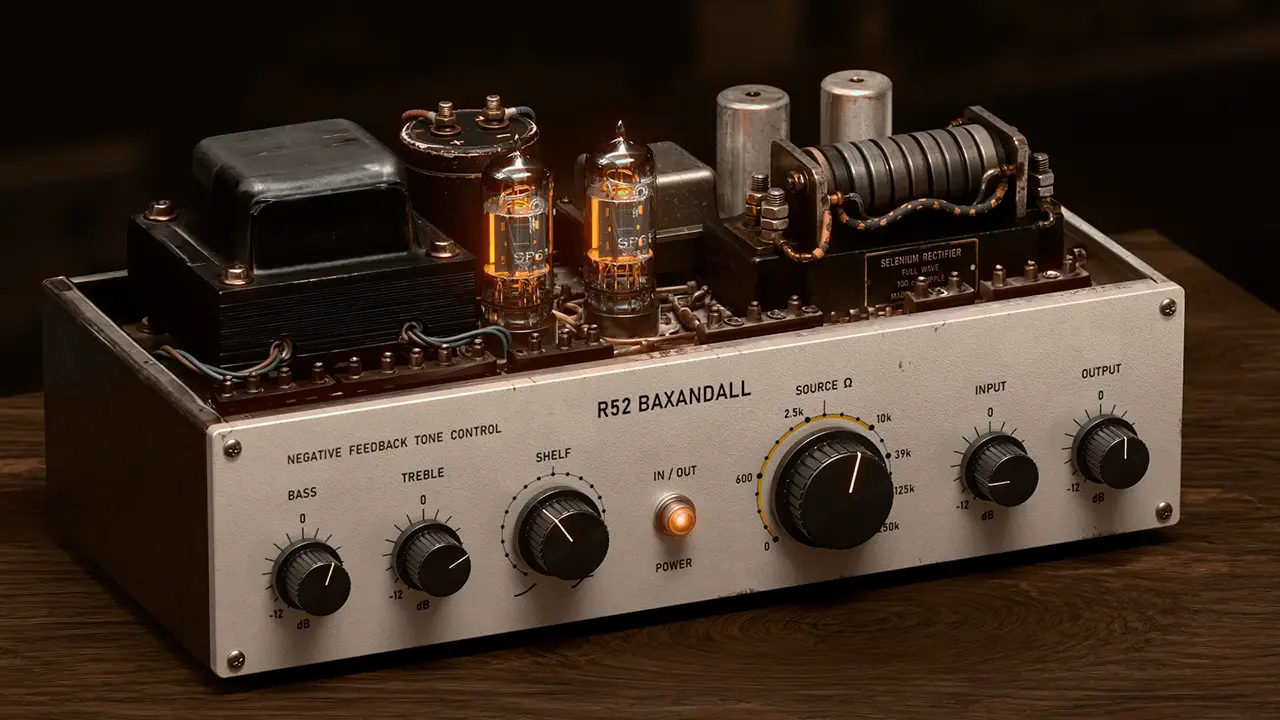
- Product: R52 Baxandall
- Developer: Pulsar Modular
- Version: 1.0.3
- Format: VST3, AU
- Requirements: Windows 10 or later, macOS 10.13 or later
- Source: pulsarmodular.com/product/r52-baxandall
R52 is a faithful reconstruction of Peter Baxandall’s original 1952 two-knob negative feedback tone control, preserved exactly as he designed it.
BASS and TREBLE are the original 1952 controls, and on most material they are all you need. They are two arms of one network rather than independent bands, so they interact. Raising one changes what the other is working against. Lifting both produces a third shape. They are deliberately broad, made for shaping the character and balance of a sound rather than chasing individual frequencies.
The valve is not sitting after the EQ as a separate color stage. It is part of the circuit that creates the EQ response, so input level changes more than loudness: it changes the sound of the move itself. INPUT therefore does more than set gain. It determines how hard the valve is working.
At normal levels, the circuit stays relatively clean and low in distortion. Push INPUT higher and the valve adds progressively more color. There is no separate clean mode or saturation switch, because there is no separate saturation stage to bypass. Lower input is cleaner; higher input is more colored. INPUT lets you choose where the sound sits between those two conditions.
SHELF chooses between the two treble behaviors Baxandall published for the 1952 circuit, from a lift that keeps climbing to one that bends into a shelf. In the 1957 network only the counterclockwise end is his, and there the dial acts as a top-end control in its own right. SOURCE selects what feeds the EQ; LOAD represents the amplifier and loudspeaker at the far end. These were facts of a 1952 installation, and R52 puts them under your fingers without changing the underlying circuit.
R52 also extends the original into a modern instrument. Baxandall’s design was mono. R52 can run on any channel count, from a single channel through immersive beds, with one modeled valve circuit per channel.
Version History
v1.0.3 (September 16, 2026)
- Installers for macOS and Windows
- User guides v1.0.3 (EN, DE, JA)