


- Product: PhenoType
- Developer: Sonic Charge
- Version: 1.0
- Requirements: Sonic Charge Synplant 2
- Source: soniccharge.com/phenotype
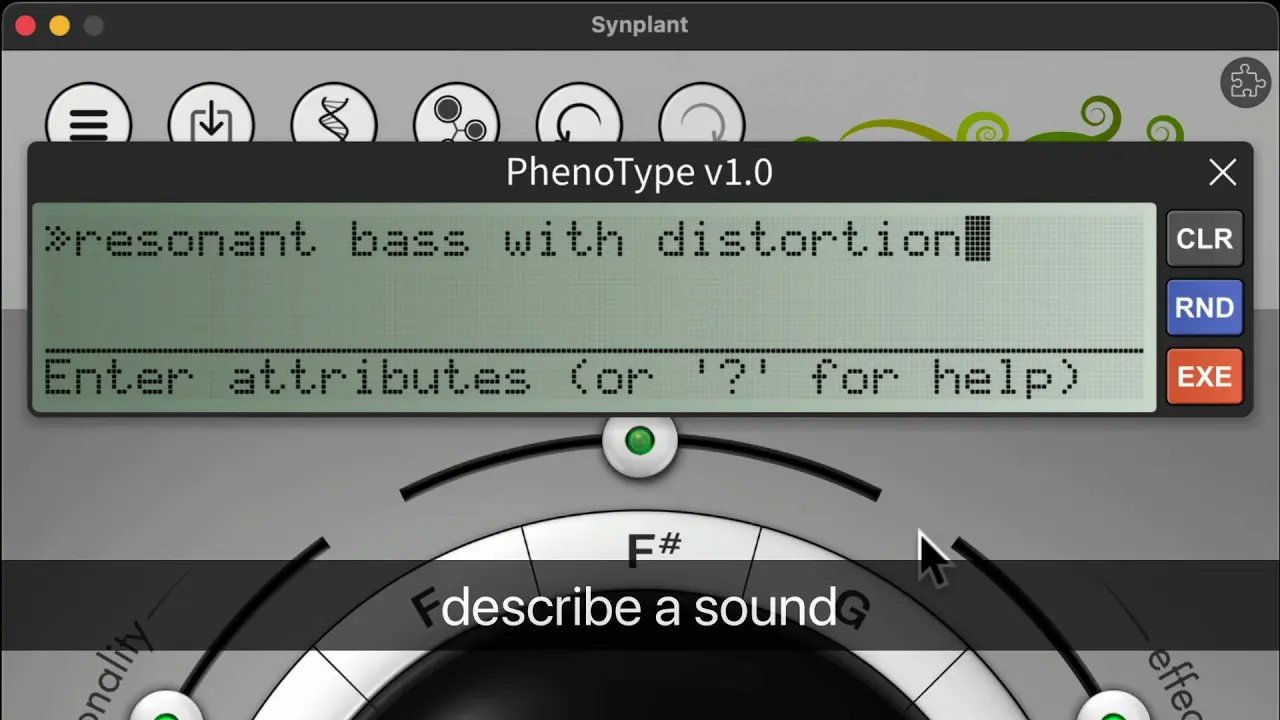
PhenoType is a free JavaScript script extension for Synplant 2 that generates fully editable synth patches from typed text descriptions. It runs entirely inside Synplant 2’s local scripting engine with no cloud processing and no internet connection. The underlying algorithm is the reverse operation of an existing Synplant 2 technology: Sonic Charge built a patch-description system that converts Synplant patches into words and tags, then inverted that mapping — text in, patch out. The result is not an LLM-based system; a few hundred internal tags with synonyms and negation handling map the input to Synplant parameters directly. Every output is a native Synplant patch that opens into the full Genopatch, mutation, and branch workflow immediately. The search intent it answers is “text-to-patch generator for Synplant 2” and “generate synth sounds from description locally.”
Key Takeaway
PhenoType is active in sessions where a Synplant 2 patch needs to exist before the sound design process begins — a structural starting point that carries specific tonal intent before mutation and branch exploration take over. It displaces the blank-init-patch problem, not the sound design problem itself. The tag vocabulary covers a few hundred descriptors; abstract, relational, or metaphorical descriptions fall outside its parser and return randomized patches rather than approximate matches. Producers who prefer building from scratch inside Synplant 2’s genetic wheel get less from it; the tool’s value concentrates at the moment before the wheel opens.
Genopatch-in-Reverse — The Algorithm That Built It
Synplant 2’s Genopatch analyzes incoming audio and reconstructs the signal as a native Synplant patch by mapping sonic characteristics to synth parameters. Sonic Charge built a parallel algorithm that runs the opposite direction: it converts Synplant patches into natural-language descriptions using words and tags. PhenoType is that conversion algorithm inverted — description in, patch out. The two systems share the same underlying tag vocabulary and parameter mapping; the directionality is what changes.
This lineage matters for understanding what PhenoType can and cannot do. It is constrained by whatever the patch-to-description algorithm can articulate — the internal tag set, the parameter relationships it knows how to express, the vocabulary it was built around. It cannot describe or generate patch characteristics that Genopatch’s description layer does not cover. A sound design outcome requiring parameters outside that vocabulary range produces either a randomized result or a close approximation using the nearest available tags.
EXE, RND, and the Tag-Based Parser
The interface is a floating text field with two controls. EXE submits the current description and generates a patch; clicking it again re-runs the same description through the algorithm to produce a different interpretation. RND ignores the text field and generates a description autonomously, then immediately patches from it — a blind random-seed mechanism that uses the algorithm’s own tag vocabulary rather than a human-supplied prompt.
The parser maps typed input against a few hundred internal tags and their synonyms, common misspellings, and simple negation constructions. “Without reverb” and “not distorted” parse as inversions that suppress the corresponding parameter ranges. Tag-style input without grammatical syntax — “slow pad modulation reverb” — produces the same results as a full phrase, since the parser extracts tags rather than processing sentence structure. Descriptions that contain no parsable tags generate a randomized patch rather than returning an error, which means mistyped or unrecognized input fails silently into randomization. There is no feedback from the parser about which parts of a description were understood and which were ignored.
Output as Native Synplant Patch — Mutation, Branch, Genopatch Access
Every PhenoType output lands in Synplant 2 as a fully native patch with no format distinction from a manually built or preset-loaded sound. The patch opens immediately into Synplant 2’s full genetic workflow: the branch wheel shows the generated patch at center, branches extend outward as parametic variations, and any branch can be planted as a new seed to start a variation cycle from that point. Genopatch can be run on the PhenoType output, treating the generated patch’s sonic character as an audio analysis input to further mutation — using text-to-patch and audio-to-patch in sequence on the same starting sound.
The editable output is the structural difference from cloud-based text-to-audio tools, which produce a static WAV file. A PhenoType patch with insufficient high-frequency presence is adjusted directly in Synplant 2’s parameter architecture rather than re-prompted until a better render arrives. The workflow consequence is that PhenoType functions as a patch initialization method rather than a terminal output — it generates the starting condition for Synplant 2’s existing workflow rather than replacing it.
Local Processing, No Subscription, Synplant 2 Dependency
PhenoType runs as a JavaScript script inside Synplant 2’s plugin scripting engine. No data leaves the machine — there is no network call on EXE, no telemetry tied to descriptions entered, no cloud service behind the result. Offline machines with no internet access run it identically to connected machines. Installation requires downloading the installer package from soniccharge.com after logging in with a Synplant 2 license, then selecting PhenoType from the puzzle-icon scripts menu inside the running plugin.
The Synplant 2 dependency is a hard requirement — PhenoType does not function as a standalone plugin, does not produce patches for any other synthesizer, and is not accessible without a valid Synplant 2 license. Producers without Synplant 2 have no partial-access path; the tool does not install or run independently of the host synth. At free cost to existing Synplant 2 owners, the license consideration applies only to those evaluating PhenoType as a reason to purchase Synplant 2 rather than as an addition to a held license.
Vocabulary Ceiling and Silent Failure on Unrecognized Tags
PhenoType’s patch generation range is bounded by the internal tag vocabulary — synthesis characteristics, effects parameters, and timbral descriptors that the patch-to-description algorithm was built to articulate. Sounds requiring parameter combinations outside that vocabulary range either partially match to the nearest available tags or randomize entirely. The silent failure mode — randomized output rather than a parse error — means a description that returns a convincing-sounding but mismatched patch provides no signal that the parser ignored part of the input. Sessions where text-to-patch precision is the workflow goal need input language calibrated to Sonic Charge’s documented tag examples. PhenoType does not extend Synplant 2’s synthesis architecture; it generates patches within the same parameter space that manual patching and Genopatch occupy, not beyond it.
FAQs
-
Does PhenoType understand complex or metaphorical sound descriptions?
The parser maps typed text against a fixed set of a few hundred internal tags and their synonyms — it does not process semantic meaning, context, or metaphor. A description like “a reverb-drenched pad with slow attack” maps accurately because each component corresponds to internal tags the algorithm recognizes. A description like “the sound of an empty parking structure at 3am” contains no extractable tags and produces a randomized patch. Descriptions that partially match — some tags recognized, others not — generate patches based only on the recognized portion, with no indication of which terms were used.
-
Can PhenoType outputs be used as Genopatch audio analysis inputs?
PhenoType outputs are native Synplant 2 patches with no format distinction from any other patch in the instrument. Playing the patch and routing its audio output into Genopatch’s analysis input processes it identically to any other audio source — the resulting Genopatch patch then attempts to reconstruct the sonic character of the PhenoType output using Synplant 2’s parameter set. Chaining the two in this direction uses text-to-patch and audio-to-patch sequentially, with each pass through Synplant 2’s architecture producing variation from the previous output.
-
Does PhenoType work on audio samples the way Genopatch does?
PhenoType’s input is exclusively typed text — it has no audio analysis stage and no sample import. Genopatch handles the audio-to-patch direction and is a separate function within Synplant 2 accessed through a different part of the interface. The two tools share the same underlying parameter mapping vocabulary but operate on entirely different input types and are not interchangeable for the same task.
-
What happens when the parser does not recognize any part of a description?
Unrecognized input fails into randomization rather than returning an error or empty state — the EXE button always produces a patch regardless of input content. The same outcome occurs with blank input and with the RND button; the distinction is that RND also generates and displays the internal prompt it used. There is no parser diagnostic output visible to the user, so distinguishing a partially understood description from a fully unrecognized one requires evaluating whether the resulting patch reflects any aspect of the description’s intent.
-
Does PhenoType require internet access after installation?
No network connection is required at any point after installation. The script runs locally inside Synplant 2’s JavaScript engine, and no component of the patch generation process involves a server request. Internet access is required only during initial download from soniccharge.com, which requires authenticating with a Synplant 2 license on the Sonic Charge account. After installation, the tool is fully offline-capable with no degraded functionality on disconnected machines.

Sonic Charge PhenoType
PhenoType is a free JavaScript script extension for Synplant 2 that generates fully editable synth patches from typed text descriptions. It runs entirely inside Synplant 2's local scripting engine with no cloud processing and no internet connection. The underlying algorithm is the reverse operation of an existing Synplant 2 technology: Sonic Charge built a patch-description system that converts Synplant patches into words and tags, then inverted that mapping — text in, patch out. The result is not an LLM-based system; a few hundred internal tags with synonyms and negation handling map the input to Synplant parameters directly. Every output is a native Synplant patch that opens into the full Genopatch, mutation, and branch workflow immediately. The search intent it answers is "text-to-patch generator for Synplant 2" and "generate synth sounds from description locally."
Price Currency: USD
Operating System: Windows 10, macOS 10.13
Application Category: Multimedia
3.9