


- Product: Guitarist Library
- Publisher: Sugar Bytes
- Version: 1.0.4
- Format: VST2, VST3, AAX, AU
- Requirements: Windows 7 or later, macOS 10.13 or later
- Source: https://sugar-bytes.de/guitarist
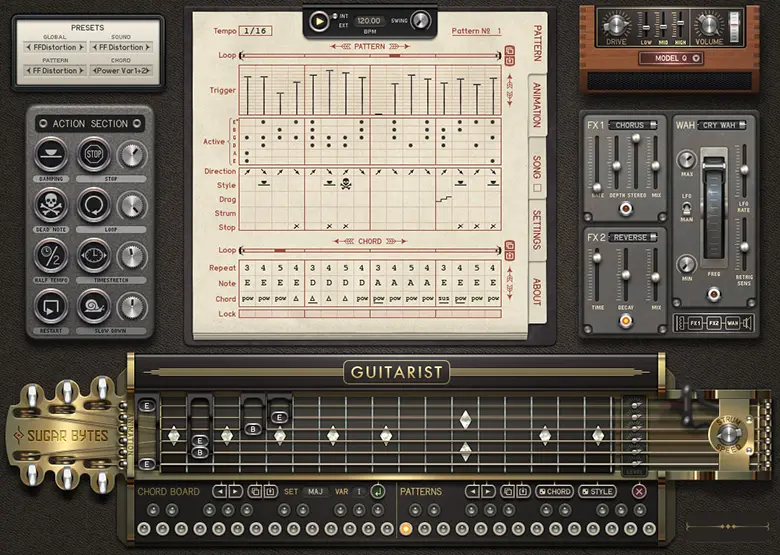
Sugar Bytes Guitarist is a pattern-based virtual guitar instrument that transforms MIDI chord input into realistic strumming and picking performances. Using a combination of chord recognition and pattern-driven articulation, it generates dynamic guitar rhythms without requiring detailed MIDI programming. With multiple guitar models, performance controls, and built-in effects, it functions as a fast production tool for creating mix-ready guitar parts in modern music workflows.
Key Takeaway
Guitarist converts simple MIDI chords into realistic guitar performances through pattern-based strumming and articulation, prioritizing speed and usability over detailed manual control.
When programmed guitars sound correct but feel disconnected
Creating realistic guitar parts inside a DAW often results in technically correct but musically static performances. MIDI chords can trigger samples accurately, yet the absence of strumming variation, picking direction, and rhythmic nuance makes the result feel mechanical. Achieving convincing guitar movement typically requires detailed MIDI programming or multiple specialized libraries, which slows down workflow.
Guitarist is a pattern-based virtual guitar instrument that combines chord triggering, strumming engines, and performance modeling, designed for generating realistic guitar rhythms and phrases from MIDI input
It transforms simple chord input into structured guitar performances by applying predefined playing patterns and articulation behavior instead of requiring manual MIDI programming.
Guitarist uses a dual-engine system: a chord recognition module that interprets MIDI input and a pattern engine that applies strumming, picking, and rhythmic articulation. Patterns control timing, velocity, and string behavior, while additional modules shape tone and performance feel within the plugin.
Pattern-based guitar instruments simulate performance rather than individual note playback
Pattern-based guitar plugins generate realistic performances by combining chord detection with pre-programmed playing styles. Instead of triggering individual notes manually, the user provides harmonic input while the engine applies strumming direction, timing variation, and articulation patterns. These systems replicate real guitar behavior such as up/down strokes, muted hits, and rhythmic accents. They are commonly used in pop, electronic, and film production where convincing guitar parts are required without recording a live instrument.
Where MIDI chord input fails to translate into realistic guitar performance
Standard MIDI instruments treat chords as simultaneous note events. While this works for keyboards and pads, it does not reflect how guitars are physically played. Real guitar performance involves sequential string hits, directional strumming, and dynamic variation between strokes.
Guitarist addresses this by separating what is played (chords) from how it is played (patterns). The user inputs harmony, and the pattern engine determines timing, articulation, and movement. This removes the need to manually program strums or picking sequences, allowing realistic guitar parts to be generated quickly from simple MIDI input.
Pattern engine defines rhythmic identity and articulation behavior
The core of Guitarist is its pattern system, which controls:
- Strumming direction (up/down strokes)
- Timing offsets between strings
- Velocity variation and accents
- Muted and ghost notes
Patterns act as performance templates rather than static loops. When combined with chord input, they generate evolving rhythmic behavior that adapts to the progression.
Because articulation is embedded in the pattern rather than triggered manually, the resulting performance feels more consistent and natural compared to note-by-note MIDI programming.
Multiple guitar models provide distinct tonal roles
Guitarist includes several guitar types designed for different production contexts:
- Clean electric
- Muted electric
- Acoustic-style tones
- Processed or stylized variants
Each model is recorded and processed to fit specific roles, such as rhythmic comping, muted funk patterns, or ambient textures. Instead of offering deep amp simulation or tone design, the plugin provides pre-shaped tonal identities that integrate quickly into a mix.
This approach prioritizes usability over full control of the guitar signal chain.
Performance controls adjust realism without breaking workflow speed
Guitarist includes macro-style controls for shaping playback:
- Timing tightness
- Groove feel
- Dynamics and accent strength
- Humanization
These controls operate globally rather than per-note, allowing quick adjustment of performance character without editing MIDI data. This maintains the plugin’s focus on speed and immediacy while still allowing variation in feel.
The result is a system where realism is adjusted at the performance level rather than through detailed programming.
Built-in effects support mix-ready output rather than deep processing
The plugin includes integrated effects such as amp-style processing, delay, reverb, and modulation. These are designed to provide immediate usability rather than detailed tone shaping.
Because the guitar tones are already processed, the effects act as finishing tools rather than core sound design elements. This reduces setup time but limits flexibility for users who prefer building custom amp and FX chains externally.
Strength vs limitation comes down to control vs speed
Guitarist excels at generating convincing rhythmic guitar parts quickly, but it operates within a structured system:
- Patterns define articulation behavior
- Limited control over individual string-level detail
- Pre-shaped tones reduce deep customization
This makes it highly effective for songwriting and production workflows, but less suitable for detailed guitar programming or realistic solo performance modeling.
A performance-driven guitar instrument built for fast arrangement work
Guitarist is designed to bridge the gap between MIDI programming and realistic guitar performance. Its pattern-based system removes the need for detailed articulation editing, allowing users to generate usable guitar parts within seconds. The trade-off is reduced flexibility at the micro level, as performance is shaped by predefined patterns rather than individual note control. In workflows focused on songwriting, pop production, and arrangement, it provides a fast and effective solution; in highly detailed guitar simulation contexts, it becomes more limited.
FAQs
-
What type of plugin is Sugar Bytes Guitarist?
It is a pattern-based virtual guitar instrument designed to generate realistic strumming and picking from MIDI chords.
-
Do you need to program individual guitar notes?
No. The plugin uses patterns to generate articulation automatically from chord input.
-
Can Guitarist be used for lead guitar parts?
It is primarily designed for rhythm and pattern-based playing rather than expressive lead performance.
-
Does it include guitar tones and effects?
Yes, it includes pre-shaped guitar sounds and built-in effects for mix-ready output.
-
Is Guitarist suitable for beginners?
Yes, it simplifies guitar performance creation, making it accessible without detailed MIDI programming knowledge.
Sugar Bytes Guitarist Library

Sugar Bytes Guitarist is a pattern-based virtual guitar instrument that transforms MIDI chord input into realistic strumming and picking performances. Using a combination of chord recognition and pattern-driven articulation, it generates dynamic guitar rhythms without requiring detailed MIDI programming. With multiple guitar models, performance controls, and built-in effects, it functions as a fast production tool for creating mix-ready guitar parts in modern music workflows.
Price: 129
Price Currency: USD
Operating System: Windows 7, macOS 10.13
Application Category: Multimedia
4.5