


- Product: Superior Drummer 3
- Publisher: Toontrack
- Version: 3.4.4 Update
- Format: Standalone, VST, VST3, AU, AAX
- Requirements: Windows 10 or later, macOS 10.13 or later
- Source: toontrack.com/product/superior-drummer-3
Superior Drummer 3 is a virtual drum instrument built on a 230 GB sample library recorded at Galaxy Studios by George Massenburg, with per-drum bleed control, 11 ambient mic channels per kit, 35 insert effects, and an integrated mixer running before the signal reaches the DAW. The Grooves tab’s Tap2Find function searches the MIDI library by a played rhythmic pattern; the Tracker tab converts multi-track drum audio to MIDI using a neural network. v3.4.4, the current release, improves multi-core CPU performance — most noticeably on Mac — and resolves the highest-priority crash in the prior version: a Mixer crash triggered by selecting a Mic channel on project load when no Mic channel was visible at the time the GUI last rebuilt. It answers the query: how do I build a production-ready drum performance — from groove search to full mixed bus — without leaving a single plugin window.
Key Takeaway
Producers and engineers running dense SD3 sessions on Mac hardware — multiple CPU cores active, large SDX libraries loaded, high voice counts — receive the most direct benefit from v3.4.4’s performance update. The Mixer crash fix addresses a reproducible failure condition on project load that affected any session where a Mic channel was active but not visible when the project was last saved; it was the most reported crash in the 3.4.3 cycle and the highest-priority fix in this release. The update contains no new features, no content additions, and no interface changes — sessions not affected by the specific Grid Editor, Song Track, or Mixer bugs in v3.4.3 will notice only the CPU performance improvement.
Galaxy Studios Sample Architecture
The 230 GB core library covers six acoustic kits — Gretsch, Ayotte, Pearl, Yamaha, Premier, and Ludwig — recorded with a microphone configuration extensive enough to provide 11 ambient channels per kit, accessible whether the session output is stereo or surround. Each kit includes more than 30 snare options and a comparable kick drum selection, all at 44.1 kHz / 24-bit. The recording process under George Massenburg produced samples that carry the acoustic character of the Galaxy Studios hall rather than a treated isolation room — the room mics aren’t a reverb supplement but a primary tonal component of how each kit sounds at distance.
Kit pieces mix freely across SD3 libraries and SDX expansion packs within a single kit, and the drum-stacking feature layers multiple pieces — including imported third-party samples — into one velocity-mapped instrument. Each layer in a stack carries independent level, tuning, pitch envelope, and velocity gate settings. Previously released SDX libraries retain their original channel count and don’t gain additional mic positions when loaded in SD3.
Tap2Find, Song Creator, and the Groove Workflow
Tap2Find accepts a played rhythmic pattern — kick, snare, or any combination — on a looping two-bar canvas, then searches the full MIDI library for clips that match or complement what was played. The search accounts for pattern similarity rather than exact matching, which means a basic kick-snare idea surfaces both close matches and suitable variations the producer wouldn’t have found by browsing manually. The result set populates instantly and clips audition against the current kit without additional setup.
Song Creator takes a single clip — from the Tap2Find results or from the library directly — and populates a panel with verse, pre-chorus, chorus, and transition options. Dragging from the Song Structures section places a complete song-length arrangement onto the Song Track in one operation. Several standard song form templates (AAA, ABAB, ABCABC) serve as the structure scaffolding, and custom structures can be saved for reuse.
The Song Track holds multiple simultaneous tracks for comparing different arrangement options, follows the host DAW transport when SD3 runs as a plugin, and accepts tempo envelopes and time signature changes. MIDI clips on the Song Track open in a grid editor for per-hit timing, velocity, and articulation editing, or in the Play Style panel for broader velocity and density adjustments per drum lane.
Mixer Architecture and the 35 Insert Effects
The SD3 mixer handles groups, buses, routing, and sends in the same configuration as a hardware console, with individual bleed control per mic channel. Bleed amount per channel is adjustable independently — adding snare bleed into the room mics, or removing kick bleed from the overhead, without touching other routing. All 11 ambient mic channels are accessible in a stereo session, functioning as alternative ambience options rather than requiring surround output to be active.
The 35 insert effects cover EQ, dynamics, delay, reverb, distortion, modulation, and transient processing, including compressor models based on the 1176 and Fairchild 670 alongside a multiband compressor, frequency gate, tape simulator, and tape delay. Third-party VSTs cannot be loaded inside the SD3 mixer — processing that requires a specific plugin not in the built-in set must be applied downstream via multi-output routing to the DAW. The Macro Controls system assigns up to 100 rotary knobs to any combination of mixer, effects, or drum parameters, with DAW automation and MIDI controller mapping per macro.
Tracker: Neural Network Drum Detection and Its Boundaries
Tracker accepts WAV, AIFF, FLAC, OGG, and MP3 files via drag-and-drop, identifies the instrument category of each track using neural network recognition, detects transients while suppressing bleed from adjacent channels, and exports the result as MIDI — either a combined clip or per-drum files — directly into the Song Track. On close-mic multi-track recordings with clean separation between drum channels, the detection runs without user intervention and captures the original performance’s dynamic range and hi-hat articulations accurately.
On mixed stereo recordings, Tracker can still extract useful MIDI by duplicating the stereo file into multiple analysis tracks — each instance set to target a different drum. This approach requires more manual threshold and sensitivity refinement per drum than a multi-track pass does. Detection on bleed-heavy stereo sources, particularly hi-hat and snare separation, produces the least reliable results and requires the most manual correction in the hit editor.
Tracker builds a tempo map from the audio, exports MIDI with tempo and time signature data, and provides per-section detection sensitivity controls for recordings with dynamic variation between song sections. The output MIDI routes into SD3’s Song Track for further editing rather than exporting directly to the host DAW timeline as a first step.
E-Drum Integration and MIDI Mapping
The E-Drums tab transforms incoming MIDI from a connected electronic kit to match the SD3 library’s velocity and articulation expectations, operating independently from the MIDI files in the library — playing live with an e-kit and triggering saved MIDI clips simultaneously uses the same kit configuration without one affecting the other. Presets for Roland, Yamaha, Alesis, and other major e-drum brands handle the base mapping with per-pad fine-tuning available for sensitivity, curve shape, and articulation assignment.
MIDI remapping adjusts which MIDI note triggers which drum at the global level, with velocity curve shaping and a smoothing function for hand-played rolls that reduces machine-gun repetition artifacts on rapid repeated hits. The Alesis Strata Core and Strata Prime presets received specific updates in v3.4.4 following reports of mapping inconsistencies with those kits. Multi-core CPU performance also improved in v3.4.4, with the most pronounced gain on macOS.
Third-Party SDX Expansion and the Per-Kit Mic Channel Ceiling
SD3’s expansion system covers SDX packs for new acoustic kits, electronic sounds, and orchestral percussion, with the full catalogue of SD2 content loading inside the SD3 environment using its own mixer integration. SDX content slots into the SD3 mixer with the channel configuration it was originally recorded with — a library recorded with eight close-mic channels loads with eight, not eleven, regardless of what the SD3 core kits provide. Mixing kit pieces from an SDX alongside core SD3 drums in a single kit is fully supported; each piece retains its own channel complement within the shared mixer.
Third-party MIDI works with Tap2Find’s search algorithm, expanding the match pool beyond Toontrack’s own groove library. Custom instruments — including stacks built from imported samples — can be saved and recalled across sessions independently of the preset library. The plugin’s mixer outputs can route each drum and ambient channel to a discrete DAW channel for external processing, which is the workaround for the limitation that SD3’s internal mixer doesn’t host third-party VST insert effects.
FAQs
-
Does SD3 work without downloading the full 230 GB library before starting?
The core library must be installed before SD3 can load its kits — Toontrack’s Product Manager handles installation and allows selection of which kits to install if full disk space isn’t available. An SSD option ships the library on physical media for users who can’t download 230 GB. SDX expansion packs are additional downloads on top of the core library.
-
Can Tracker extract MIDI from a commercially released mixed stereo drum recording?
Tracker is designed for multi-track close-mic recordings where each drum occupies a separate channel with minimal bleed. On a commercially mixed stereo file, all drums share the same two channels, and bleed between instruments is present throughout — detection accuracy drops significantly, particularly for hi-hat and snare separation, and requires manual hit-by-hit correction. Toontrack’s documentation recommends multi-track source files for production-quality results.
-
Can third-party VST plugins be used inside the SD3 mixer?
The SD3 mixer’s 35 insert effects are the only processors available inside the plugin — third-party VSTs cannot be loaded as inserts in the SD3 mixer. Processing with external plugins requires routing individual drum channels to separate DAW outputs via SD3’s multi-output system and inserting processors on those channels in the DAW mixer.
-
What is the difference between the SD3 core library and SDX expansion packs?
The core library includes six acoustic kits recorded at Galaxy Studios with 11 ambient mic channels each, approximately 350 electronic sounds, and a percussion collection totaling 230 GB. SDX packs add new complete kits, sounds, or content categories — each with their own recorded mic channel count, which doesn’t change when loaded in SD3 regardless of the core library’s channel configuration. Core library content and SDX content can be mixed freely within a single kit.
-
Does the v3.4.4 update require a full reinstall or does it apply over the existing installation?
v3.4.4 installs via Toontrack’s Product Manager as an update to the existing SD3 installation — no reinstall of the sample library is required. The update addresses one multi-core CPU performance improvement, a Logic Pro and GarageBand menu click registration bug, two Grid Editor issues, a Mixer crash on project load, a Song Track Edit menu keyboard shortcut fix, and updated Alesis Strata Core and Strata Prime e-drum presets.
Toontrack Superior Drummer 3.4.4 Update
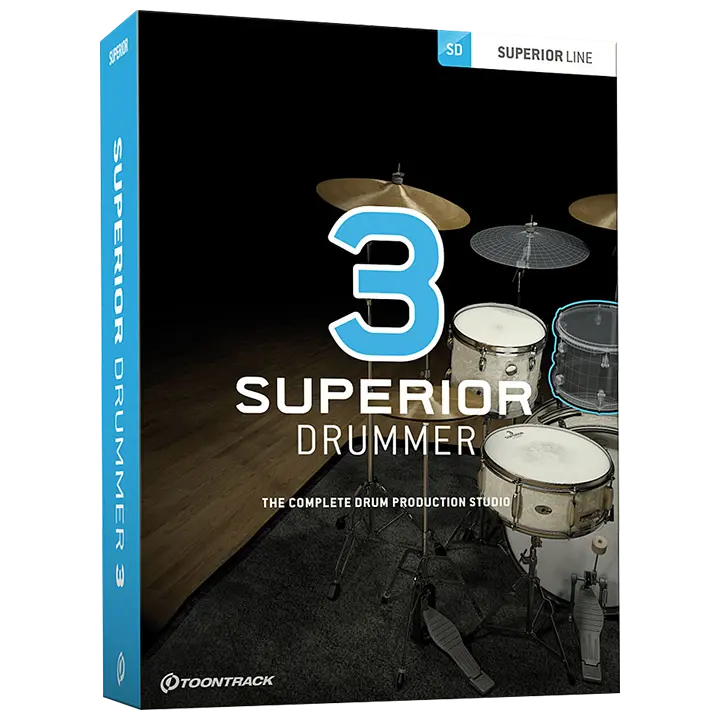
Superior Drummer 3 is a virtual drum instrument built on a 230 GB sample library recorded at Galaxy Studios by George Massenburg, with per-drum bleed control, 11 ambient mic channels per kit, 35 insert effects, and an integrated mixer running before the signal reaches the DAW. The Grooves tab's Tap2Find function searches the MIDI library by a played rhythmic pattern; the Tracker tab converts multi-track drum audio to MIDI using a neural network. v3.4.4, the current release, improves multi-core CPU performance — most noticeably on Mac — and resolves the highest-priority crash in the prior version: a Mixer crash triggered by selecting a Mic channel on project load when no Mic channel was visible at the time the GUI last rebuilt. It answers the query: how do I build a production-ready drum performance — from groove search to full mixed bus — without leaving a single plugin window.
Price: 239
Price Currency: EUR
Operating System: Windows 10
Application Category: Multimedia
4.6