


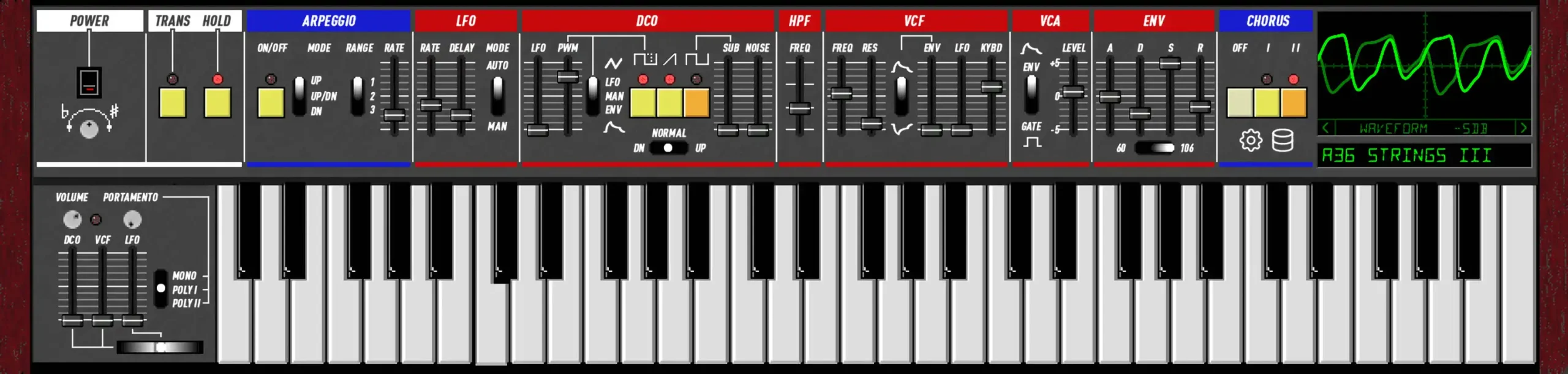
- Product: Ultramaster KR-106
- Developer: Kayrock Screenprinting
- Version: 2.5.12
- Format: Standalone, VST3, AU, CLAP, LV2
- Requirements: Windows 10+, macOS 10.15+, Ubuntu 20.04+
- Source: https://kayrock.org/kr106/
Ultramaster KR-106 is a free, open-source virtual analog synthesizer modeling both the Juno-60’s continuous analog signal path and the Juno-106’s firmware-controlled path, down to the latter’s 238.1 Hz update tick. A per-voice Component Variance editor reproduces real analog component tolerance spread, and a modeled MN3009 BBD circuit drives the chorus. 256 factory presets split across two mode-specific banks, and bidirectional Juno-106 SysEx lets the plugin mirror state with physical hardware. Search intent: a circuit-accurate, GPL3 Juno-60/106 emulation with dual-mode DSP.
Key Takeaway
Recreating a specific Juno-60 or Juno-106 patch down to its firmware-level modulation stepping activates 106 mode and the Component Variance editor together. Blending both eras’ character in a single patch isn’t possible — one mode’s bank and signal path load at a time. Producers wanting a generic vintage-analog pad without matching real hardware behavior can leave variance at Robot Tune.
The 238.1 Hz Firmware Tick
60 mode’s VCF cutoff runs through the IR3109 exponential converter fed directly by analog CV, with envelope, LFO, and keyboard tracking summed continuously; range spans roughly 2 Hz to 40 kHz, with keyboard tracking referenced to C1. 106 mode digitizes that same cutoff to a 7-bit value, sums modulation in fixed-point firmware arithmetic, and updates at a 238.1 Hz tick rate — 4.2ms per step — smoothed afterward by a 1ms RC filter, with keyboard tracking referenced to middle C instead.
The envelope stage carries the same split. 60 mode’s RC attack curve charges toward a 1.2x overshoot target for a concave analog shape, with exponential RC discharges on decay and release (Attack 1ms–3s, Decay/Release 3ms–22s). 106 mode runs a 16-bit accumulator at the same 238.1 Hz rate, producing a linear attack ramp and a ROM-table staircase approximation of exponential decay and release (Attack 1ms–3.3s, Decay/Release ~1.5ms–25.5s).
Switching modes remaps the VCF frequency slider automatically to hold the same Hz value on the new curve, and each mode keeps its own bank of 128 factory presets rather than sharing one list.
The firmware-timed 106 path updates cutoff and envelope in discrete 4.2ms steps rather than continuously, so fast modulation at high resonance can show stepping the analog 60 path won’t. Programmers chasing the digitally quantized Juno-106 character work in 106 mode; those after the earlier Juno-60 envelope shape switch to 60.
HPF Steps in Four, Not a Sweep
The DCO mixes pulse, saw, and a sub-oscillator one octave down, switchable across 4′, 8′, and 16′ ranges, with pulse width driven by LFO, a fixed manual slider, or the envelope. White noise mixes in as a separate control from sub level. The high-pass filter runs as a 4-position switch that thins low end rather than a continuously variable sweep.
The IR3109-modeled VCF carries resonance up to self-oscillation, envelope amount with switchable polarity, LFO-driven cutoff wobble, and keyboard tracking that opens the filter further on higher notes. Filter oversampling runs at 4x by default, keeping self-oscillation tracking clean up to 20 kHz; 2x trades some aliasing risk at high cutoff and resonance for lower CPU load, and turning oversampling off removes that safeguard entirely.
Running with oversampling off risks instability at high resonance rather than just adding noise. Sound designers pushing near self-oscillation get the cleanest tracking at 4x; those running many voices on a constrained CPU budget can drop to 2x or off to reclaim headroom, at that cost.
Variance That Doesn’t Follow the Patch
Chorus runs Off, I (subtle, slow modulation), or II (wider, faster), with I and II combinable for a third character, all through a modeled MN3009 BBD circuit. A BBD Drive control adds saturation on the chorus’s BBD input, with 0% disabling that saturation stage outright.
The Component Variance editor exposes per-voice offsets for VCF cutoff (±10 cents), DCO pitch (±30 cents), envelope timing scale (±15 percent), VCA gain (±12 percent), and pulse-width min/max — the tolerance spread a real analog polysynth shows between voices. Three tune presets span Robot Tune (every voice identical, noise and BBD drive zeroed), Human Tune (offsets at a fifth of full range), and Out of Tune (full random spread).
A deterministic offset set generates on first launch to model one specific hardware unit, and that variance persists globally across sessions. Analog noise floor, mains hum harmonics, and BBD clock feedthrough sit as separate global sliders alongside the per-voice variance.
Variance applies globally rather than per preset, so switching patches doesn’t carry a different simulated unit’s character with it. Producers wanting exact-spec Robot Tune character for sound design leave variance untouched; those chasing worn-hardware character dial in Human or Out of Tune once and hear it across every patch.
Arp and LFO Locked to Multiples
The arpeggiator runs Up, Up/Down, or Down across 1, 2, or 3-octave range, with a Hold mode that releases individual held notes independently and a Transpose mode that reassigns key-clicks to root-note changes instead of playing notes.
Sync Arp to Host locks arp rate to the DAW’s tempo, snapping the rate slider to note divisions from 4 Beats down to 32nd, aligning steps to the beat grid while the transport plays and free-running at the tempo-matched rate when it’s stopped. Sync LFO to Host does the same for LFO rate and resets LFO phase on transport start; with both synced, their rates lock to exact multiples of each other.
If the host doesn’t report tempo, sync silently disables and the arp falls back to its rate slider instead of flagging the drop. LV2 hosts that send transport updates only on state changes, such as Jalv or Zynthian, are named as compatible with this sync behavior specifically.
Producers building tempo-locked arpeggiated patterns get exact-multiple arp/LFO relationships without manual rate math; those using the arp as a manual performance tool leave sync off and drive rate from the slider directly.
Presets Save Everything Except Performance
256 factory presets split across two banks — 128 decoded from original Juno-106 factory SysEx dumps in 106 mode, and 128 recovered from Juno-60 factory tape backups in 60 mode (Bank A: 56 named patches across strings, brass, keyboards, organs, leads, and effects; Bank B: unnamed tape presets). The Patch Bank view lays out all 128 current-mode presets in a 16×8 grid, with a drag-and-release bouncing-ball gesture that cycles through presets as it travels.
The patch manager saves the current sound to any bank/group/patch slot, clears a slot to an init patch, loads a CSV patch bank file, or reveals the preset storage folder — all from one right-click menu. Typing while the patch grid is open filters by name, dimming non-matches so arrow keys skip over them.
Presets save every synthesis parameter, but performance controls — Tuning, Transpose, Hold, Arpeggio, Arp Rate/Mode/Range, and Portamento — are excluded and persist independently instead, so switching patches mid-performance doesn’t reset an arp pattern or transpose already dialed in. Sound designers archiving new patches use the save flow directly; performers switching sounds live rely on that exclusion to keep a setting in place across a set.
IPR and APR, By the Byte
The plugin receives standard MIDI CC, original Juno-106 SysEx (F0 41 32 0n cc vv F7), and Program Change simultaneously regardless of any output setting, with MIDI Learn available on any slider, knob, switch, or button via right-click — including letting two parameters share one CC.
MIDI Out: SysEx toggles what’s transmitted rather than what’s received — off sends standard CC and Program Change, on sends Juno-106-format IPR messages per parameter change and a 24-byte APR patch dump on every preset change. That APR format matches the original hardware’s dump structure closely enough that two KR-106 instances, or a KR-106 and a physical Juno-106, can mirror each other’s state.
SysEx output has to be switched on deliberately to get hardware-format dumps out; left at the CC default, a receiving hardware unit won’t pick up parameter changes in its native format. Studios running the plugin alongside physical Juno-106 hardware get direct state-mirroring once SysEx output is enabled; those controlling the plugin from a generic MIDI controller can leave it on the CC default and never touch the setting.
What a Hardware Juno-106 Handles From Here
That handoff only happens once MIDI Out: SysEx is switched on in settings — left at the CC default, parameter tweaks in the plugin stay software-only and never reach a connected hardware unit’s Juno-106 SysEx input at all.
FAQs
-
Is Ultramaster KR-106 free to use, including commercially?
Ultramaster KR-106 ships under the GPL3 open-source license, with source code available on GitHub alongside compiled builds. GPL3 is copyleft — any modified or redistributed version must stay GPL3 and expose its source, unlike a permissive MIT license or closed commercial terms. No separate commercial license applies; the compiled builds install and run the same as any other plugin or standalone application.
-
What plugin formats does KR-106 run in?
KR-106 runs as VST3, AU, CLAP, LV2, or a standalone application, along with a browser-based WebAudio version for auditioning without installing anything. The WebAudio version can carry minor audio artifacts the installed plugin or standalone build doesn’t produce. Windows builds cover both x64 and native ARM64, and Linux builds cover x86_64 and Raspberry Pi’s arm64 architecture specifically.
-
How does 60 mode differ from 106 mode in practical use?
60 mode models the original Juno-60’s continuous analog signal path; 106 mode models the Juno-106’s firmware-controlled path, including its 238.1 Hz update rate and digitized parameter handling. Switching modes swaps in a completely separate bank of 128 factory presets and remaps the VCF frequency slider to hold the same Hz value on the new curve.
-
Does changing patches interrupt an arpeggiator pattern or transpose setting mid-performance?
Performance controls — Tuning, Transpose, Hold, Arpeggio and its Rate/Mode/Range, and Portamento — are excluded from preset saves and persist independently of whatever patch loads. Switching to a new sound during a set keeps the same arp pattern, transpose root, and hold state running underneath it. Every other synthesis parameter, from oscillator waveform to envelope timing, does change with the preset.
-
Can the plugin stay in sync with a physical Juno-106?
Enabling MIDI Out: SysEx switches the plugin’s output from standard MIDI CC to Roland Juno-106-format SysEx, sending individual parameter changes as IPR messages and a full 24-byte patch dump as an APR message on every preset change. That format matches the original hardware’s dump structure closely enough for a physical Juno-106 to receive and mirror it.

Ultramaster KR-106
Ultramaster KR-106 is a free, open-source virtual analog synthesizer modeling both the Juno-60's continuous analog signal path and the Juno-106's firmware-controlled path, down to the latter's 238.1 Hz update tick. A per-voice Component Variance editor reproduces real analog component tolerance spread, and a modeled MN3009 BBD circuit drives the chorus. 256 factory presets split across two mode-specific banks, and bidirectional Juno-106 SysEx lets the plugin mirror state with physical hardware. Search intent: a circuit-accurate, GPL3 Juno-60/106 emulation with dual-mode DSP.
Price Currency: USD
Operating System: Windows 10, macOS 10.15, Ubuntu 20.04
Application Category: Multimedia
4.4