- Developer: Lucien Dargue / Emiliano Pennisi
- Release Date: 23 October 2026
- File Size: 9 MB
- Formats: Max for Live device (.amxd)
- System Requirements: Ableton Live 12.4 (latest version) + Max for Live. Mapped for Ableton Push.
Panacousticon takes its sonic vocabulary from a specific moment in the history of recorded sound: the cold, lo-fi tape-and-synthesizer culture of early-1980s European industrial and death-ambient music. It is not an emulation of any single record or studio, but a study of a timbral language — metallic detuning, frozen reverb tails, claustrophobic low end, mechanical pulses, and the particular grain of magnetic tape under stress.
Listeners who know the catalogues of labels like Cold Meat Industry, the early tape work of Atrax Morgue, or the more contemporary palette of Hospital Productions will recognise some of the same instincts at work here. None of it is reproduced directly. It’s the underlying language, not any specific record, that the bundle is built around.
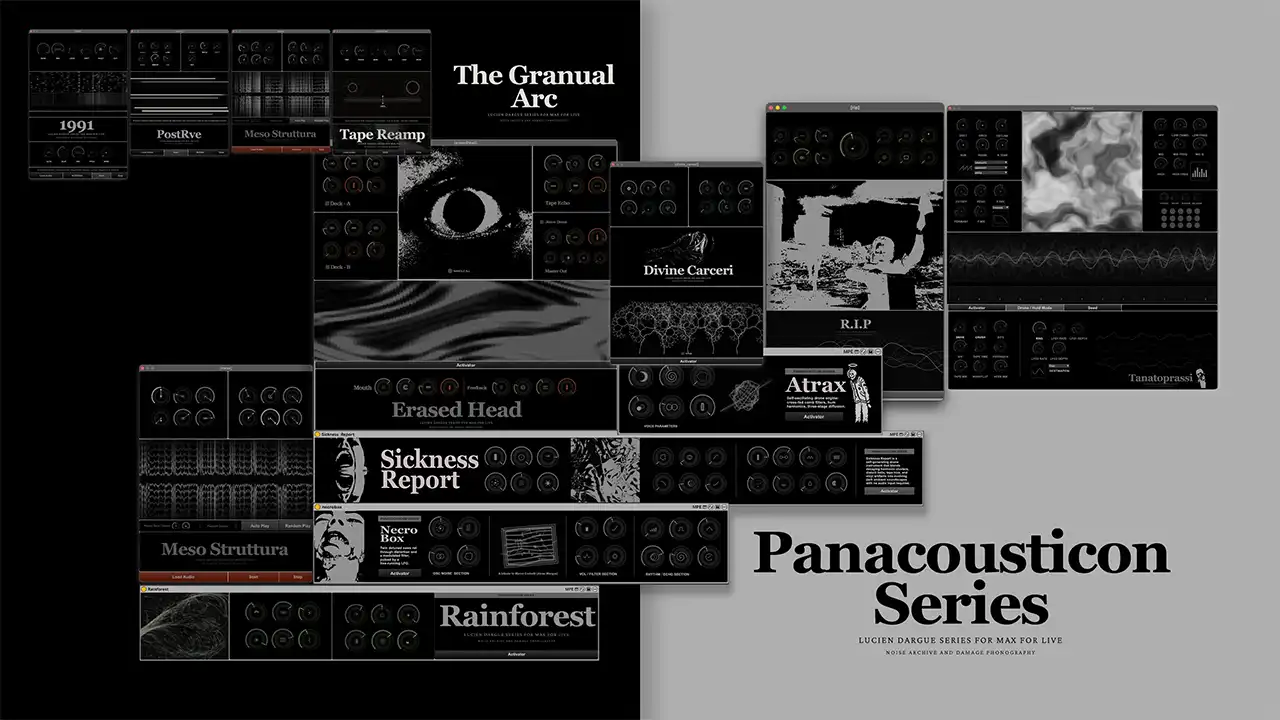
Each instrument in the bundle approaches that language from a different angle: synthesis, granular fragmentation, tape memory, generative drone, organic noise. Together they form a coherent toolkit for building cold, ritualistic, slowly decaying sound, built entirely as Max for Live devices with deep, hands-on Ableton Push mapping.
The Granular Arc
The bundle also includes a complete exploration of modern granular synthesis across three instruments. Mesostruttura works at maximum density — thousands of grains per second scattered across the entire buffer, functioning as a sonic microscope that reveals what is hidden inside a sound rather than what is already audible. Post-Rave Soundscape operates at medium density with longer grains, suspending material in space until the source dissolves into texture. 1991 locks onto a single fragment of one to twenty-two milliseconds and repeats it with almost no movement — granular synthesis at its most reduced, a single point held under pressure until repetition itself becomes the instrument. 1991 also includes a built-in generative source, requiring no external sample to run.
Taken together the three instruments cover the full range of granular processing from spectral microscopy to spatial erosion to locked repetition — three completely different results from the same underlying mechanism.