
- Product: Phantomic
- Developer: EDM Ghost Production
- Type: Multiband sound shaper
- Version: 1.1.1
- Format: VST3
- Requirements: Windows 10 or later
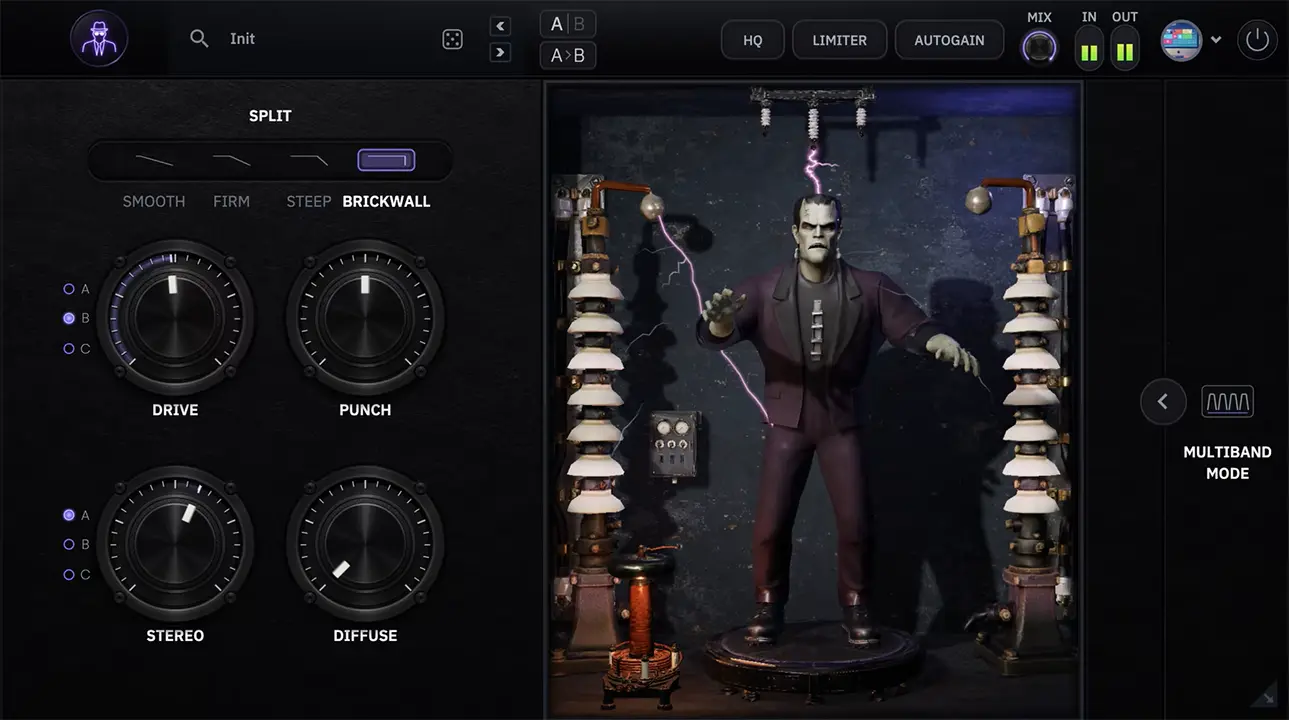
Phantomic splits your sound into four bands and gives each one four character stages: Drive, Punch, Stereo, and the signature Diffuse engine, our own tech that fattens, smears and liquefies a band the further you push it.
Not an EQ, not a compressor: it changes the texture of each region of the spectrum. Best on bass and leads, at home on anything.
The secret sauce behind the biggest drops in dance music.
Per-band saturation, stereo width and phase dispersion make everything fatter, juicier and more alive on bass, leads, drums, vocals, whatever you throw at it. The texture work the biggest producers swear by, in four knobs instead of a ten-plugin chain.
DIFFUSE. The knob other plug-ins don’t have.
Push it and the band comes loose. Round and analog at first, then liquid, smeared, drifting out of focus, motion you can feel but cannot point at. Our own engine, built from scratch: up to 56th-order phase rotation on every band. No EQ, chorus or distortion move gets you here.
- Low amounts round transients into something analog
- High amounts melt the band into a thick, liquid blur
- Stack Drive on top: juicier, with extra harmonics
- Per band: the sub stays solid while the mids churn
Know this going in: the closer DIFFUSE gets to 100%, the more it smears the attack. That is the algorithm doing its job. If the attack matters, pull MIX back to 60–80% and add PUNCH. The transient walks through dry, the tail stays liquid.
Four shapers per band.
Every band gets its own set. In Basic one macro set rides all four bands at once. In Expert you dial each band on its own.
Drive
Gain-compensated saturation: push it and the band gets richer, not just louder.
- Tube
- Tape
- Shred
Punch
Transient shaping, per band. Push it up and kicks knock, plucks bite. Pull it below zero to tuck an attack that clicks too hard. Zero is truly off.
Stereo
Width both ways, per band. Pull left and the band tightens toward mono, push right and one of three engines opens it up. Mono the sub and blow the tops wide open, same knob. In Basic the low band is never widened, so your bass never smears.
- Micro-widen
- Spread
- Haas
Diffuse
Per-band phase dispersion that fattens, smears and liquefies without touching level or pitch. The reason Phantomic exists. Reach for it first.
Macro first. Surgery second.
Start in Basic and land a sound in seconds with one set of knobs riding all four bands. When a band needs its own treatment, flip to Expert and the whole engine opens up. Same plugin, same sound, just as much control as the track asks for.
Basic
- Four knobs ride all four bands at once
- SPLIT picks the crossover character
- Fixed crossovers, nothing to set up: land on a sound in seconds
- Frankenstein reacts to your sound: DRIVE delivers electrical shocks, DIFFUSE adds tension and delayed twitches, PUNCH shapes his recoil, and STEREO changes his arm spread
Expert
- Live pre/post spectrum on a 10 Hz–20 kHz log grid
- Three movable crossovers, 6–72 dB/oct each
- Per-band gain, solo, mute and parallel MIX
- Per-band Drive / Punch / Stereo / Diffuse with own types
100 presets. Nine categories.
Organised by source, each with genuinely different per-band settings. None of them are a finished sound. Every preset is a starting point: bend any control and its character follows, so the same preset never has to land the same way twice.
- 16 Bass
- 14 Leads
- 14 Drums
- 12 Vocals
- 12 Universal
- 10 Hats
- 8 Percussion
- 8 Master
- 6 FX
What’s new in v1.1.1
- Cubase no longer freezes on load. Cubase could get stuck in a stop-and-restart loop while adding Phantomic or changing the audio setup. The plugin now reports a latency change only when the latency actually changes, so the host rebuilds its graph once and moves on. Other hosts benefit too: fewer needless delay-compensation rebuilds on buffer-size changes.
![Read more about the article Circles Drum Samples DEAD VOL 1 [MULTiFORMAT]](https://plugincrack.com/wp-content/uploads/2024/01/Circles-Drum-Samples-DEAD-VOL-1-300x300.webp "Circles Drum Samples DEAD VOL 1 [MULTiFORMAT] 2 | Plugin Crack")
![Read more about the article JTC Guitar Funk Masterclass: Box Set [TUTORiAL]](https://plugincrack.com/wp-content/uploads/2025/02/jtc-guitar-funk-masterclass-box-set.webp "JTC Guitar Funk Masterclass: Box Set [TUTORiAL] 3 | Plugin Crack")