
- Developer: Isla Electronics
- Version: 1.28
- File Size: 25 MB
- Formats: Standalone, VST3
- System Requirements: Windows 10/11 (64-bit)
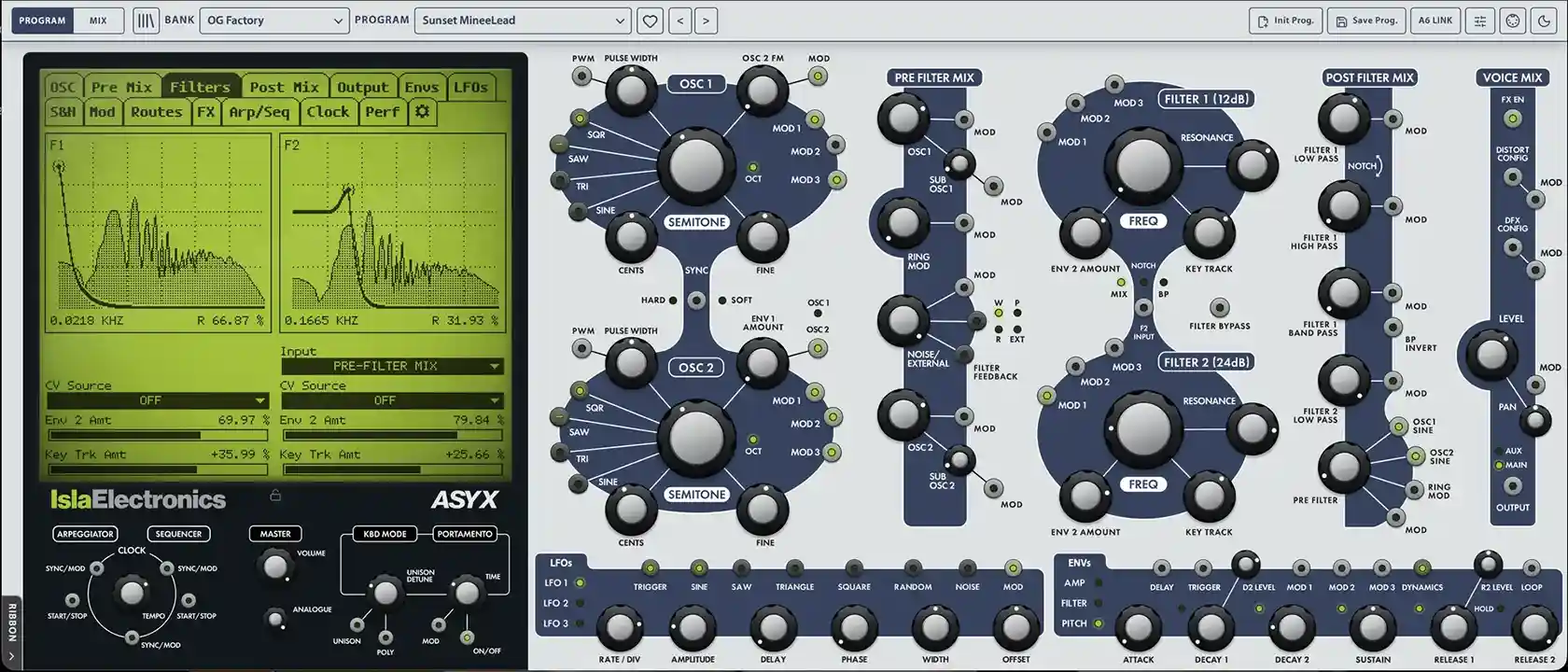
The Andromeda A6, recreated as a plugin. The architecture and sounds of the original instrument, recreated in software.
Inside ASYX
A detailed signal path, with the controls to explore it. Start simply, then go as deep as the sound requires.
Oscillators
ASYX models the behaviour of the A6’s custom oscillator ASICs, whose analogue design drew on the Moog 921B. Two oscillators per voice provide simultaneous waveforms, pulse-width control, sub-oscillators, hard and soft sync, and frequency modulation. Noise and ring modulation feed the pre-filter mixer.
Dual filters
ASYX models the A6’s filter ASICs: an Oberheim SEM-derived 12 dB/octave multimode filter and a Moog 904A-derived 24 dB/octave low-pass filter. Low-pass, high-pass, band-pass and notch responses, with series or parallel routing and separate pre- and post-filter mixing.
LFO
Three LFOs with six waveforms and individual rate, amplitude, offset, start phase, duty cycle and polarity controls. Delay, trigger and clock-sync settings are available for each LFO.
Multi-stage Envelopes
Three seven-stage envelopes: delay, attack, two decays, sustain and two releases. Nine selectable curves for each attack, decay and release stage, with adjustable intermediate levels. Additional controls cover looping, trigger and retrigger sources, velocity response, key tracking and smoothing.
Deep Modulation
Modulation routing with independent source, destination, amount, offset and enable controls. Sources include envelopes, LFOs, sample & hold, the tracking generator, MIDI and performance controllers; destinations include envelope stage times as well as oscillator, filter and effects parameters.
Sequencer / Arpeggiator
A 16-step sequencer with per-step note, velocity, gate and rest controls, alongside an arpeggiator with its own grid and setup controls. Sequence and arpeggiator settings are stored with each program.
Effects
29 digital effect algorithms, including chorus, delay, reverb and combined configurations. Algorithm parameters and effects settings are stored with each program.
Analogue character
Independent variation depths for oscillator tuning, tracking and pulse width, filter cutoff and resonance, envelope timing, voice levels, shared drift and oscillator drift. The master Analogue control scales the combined variation.
Mix mode
Up to 16 parts per plugin instance for multi-timbral operation, keyboard splits and layered stacks. Each part has its own program, MIDI channel, key range, level and output route.
Comprehensive Patch Management
More than 1,200 included programs, with original factory sounds and artist banks. Search by name, author or bank, filter by category, and keep favourites close at hand.
Your sounds. Across both instruments.
With MIDI connected in both directions, the A6’s knobs and buttons can control ASYX. Enable live parameter sending to work the other way: changes made in ASYX are sent to the hardware. This works with compatible program parameters, so you can edit from either interface.
Import original A6 SysEx programs and banks into the library, or send the current program—including unsaved edits—back to a chosen hardware slot. You can also transfer a bank. Patch and bank transfers are separate from live editing and ask for confirmation before overwriting hardware programs.
Keep large banks in ASYX, and prepare a bank in the A6’s 128-program format when you need a hardware transfer. ASYX-only features such as polyphonic aftertouch remain software features.
Epic Inspiration
The Alesis Andromeda A6 combined sixteen analogue voices, dual filters and extensive modulation in one instrument. Today, working examples are becoming harder to find, and rising second-hand prices put ownership beyond the reach of many musicians.
Maintaining them is also becoming increasingly difficult. The Andromeda relies on custom oscillator and filter chips—ASICs (Application Specific Integrated Circuits)—and many units are now out of service because replacement parts cannot be sourced.
ASYX was developed to make this instrument accessible in software. Working directly with an original A6, we’ve measured, compared and refined its behaviour, while retaining compatibility with original patches. For existing owners, it offers another way to use their sounds. For everyone else, it provides access without the cost and maintenance of ageing hardware.
An analogue ambition
The original Alesis Andromeda A6, introduced in 2000, grew out of a shared enthusiasm for the great analogue synthesizers of the 1970s and 1980s. Among its driving forces were synthesizer product manager and keyboard player Erik Norlander, engineer Rob Rampley, and Alesis founder Keith Barr. Norlander recalled persuading Barr to apply his considerable chip-design experience to an ambitious analogue polysynth. Barr subsequently designed the custom oscillator and filter chips that made the Andromeda possible. David Bryce, the synthesizer division’s marketing manager, championed the project despite internal doubts about its commercial prospects.
Making it playable
Turning that hardware into a playable instrument required substantial software engineering. Contract engineer Jeff Platt, whose background included motion-control systems for film visual effects, developed the software sound engine: its envelopes, LFOs, sequencer, arpeggiator, modulation matrix and tuning routines. Platt credited his fellow contractor Phil with the Program and Mix modes and much of the graphical interface; together they also developed the main-board circuitry. Rampley helped with processor selection and interfacing. One particularly revealing detail is that Platt’s “Control Routes”—allowing modulation itself to be modulated—emerged during development and were then incorporated into the specification.
A distinctive identity
The Andromeda’s distinctive physical appearance came from industrial designer Axel Hartmann and his company, Design Box, working closely with Norlander and Rampley. Hartmann recalled exploring several alternatives, arranging controls in drawing software and building full-size cardboard mockups to judge their layout. The resulting panel gave the instrument its recognisable groups of controls and sweeping graphics. Bryce also shaped its public identity: he proposed the name “Andromeda” and described the discussions and dealer survey that eventually secured it alongside the existing A6 designation.
The people behind the sound
Its musical character reflected a wider circle of contributors. Mike Peake worked on development, sound programming, testing and the assembly of early instruments, while Taiho Yamada contributed factory sounds and much of the original Mix programming. Other factory sound designers included Arnd Kaiser, Brian Kehew, Michael Caloroso, Pim Schilperoort and Justin Maxwell. Peake also credited Julie Yarbrough, Dave Seaton and others with helping keep the project alive through a demanding development period, and stressed the contribution of the assembly team. The original reference manual adds Dave Bertovic and Brian R. Shim to that history, crediting them with its initial and revised editions.

