- Developer: Lux Cache
- Version: 1.6.0
- File Size: 568 MB
- Formats: Standalone, VST3
- System Requirements: Windows 10/11 (64-bit)
petri is a sample-library environment built on four things: map, generate, design, and play. It maps your whole library so sounds are found by ear, generates new samples from the material you already own, lets you shape any one of them by hand, and plays and sequences all of it in one place. Four equal parts of one environment, and each one feeds the next.
what it is
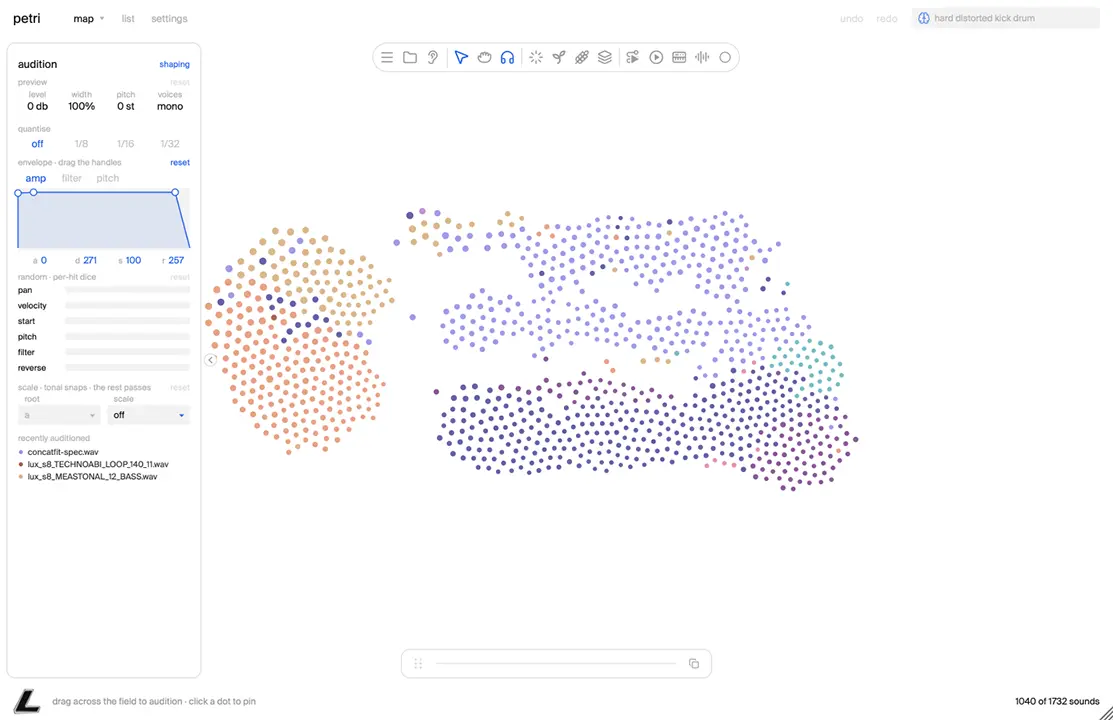
Point petri at your sample folders and every sound becomes a dot on one map. Dots are grouped by how they sound and coloured by family. From there petri does three things, and each feeds the next: map, generate, play.
- map: browse by ear, with no need to read filenames. Sweep the map to audition, search it in plain words, and find similar sounds next to each other.
- generate: four engines make new samples from the sounds you already have. spawn breeds two or three sounds into one, grow evolves a synth voice toward a target, mill grinds a neighbourhood into a texture, and stack prints a sound together with its relatives as one layered hit. Since 1.2 design sits beside them for when you want to shape one sound by hand.
- play: a keyboard instrument, two sequencers, a recorder, and a concatenative rail that answers audio you play into petri with sounds from your own library. You can play what you make as soon as it exists, and drag it into your DAW as a file.
petri / minis
petri / minis are individual rails from petri, our generative sample environment. Each one is a single rail as its own plugin: keys across a MIDI keyboard, concatenative answering what you play in, design drawn onto a waveform.
petri / keys
the whole sample library across a MIDI keyboard, four ways: an unpitched ladder, a chromatic instrument that tunes pitched samples on the fly, a block per sound family, or an auto-built drum kit.
four layouts
tonal, bright, family and drums. pick how the library lands on the keys.
auto-built kits
a full drum kit assembled from the library in one press, with a dice to re-pick every slot.
lock a sound
pin one sample to one key and the keys around it fill with similar timbres.
saved kits
layouts save as named kits, so a keyboard worth keeping is one click away next session.
petri / concatenative
play audio in and the library answers it in real time: a drum loop re-laid as a mosaic of samples you already own, a bassline sung back in the library’s own voice.
four ways to answer
mosaic re-lays the input as tiles of the library; sing pitch-tracks it; answer replies hit for hit; bloom lets the tails escape.
the library is the voice
every grain that comes back is a file already on the disk, matched against what it heard as it arrived.
in from anywhere
a sidechain input on the plugin, or a mic or interface opened straight from the rail.
shape the grains
grain length, spread, density and how long each one stays, with a dry/wet so the source can sit under its own answer.
petri / design
sound design drawn straight onto a sample’s waveform. up to three effect blocks at a time, each one shaped across the stretch of sound it covers, then flattened in and built on again.
ten blocks
vol, sub, sweep, filter, shift, noise, pitch, grain, ring and smear, each with its own automation curve.
a stretch of the sample
a block covers the part of the sound it is placed over: move it, resize it, bend its curve, fade its edges.
render and keep going
flatten the chain into the sample and the three slots free up, so the next pass builds on the last.
or roll the dice
let it build the chain, then take over wherever it landed.
all three come with petri
The three plugins on this page are three parts of a larger instrument: a map of the whole library, four engines that generate new samples from it, two sequencers, and every Lux Cache Season pack to start from.