
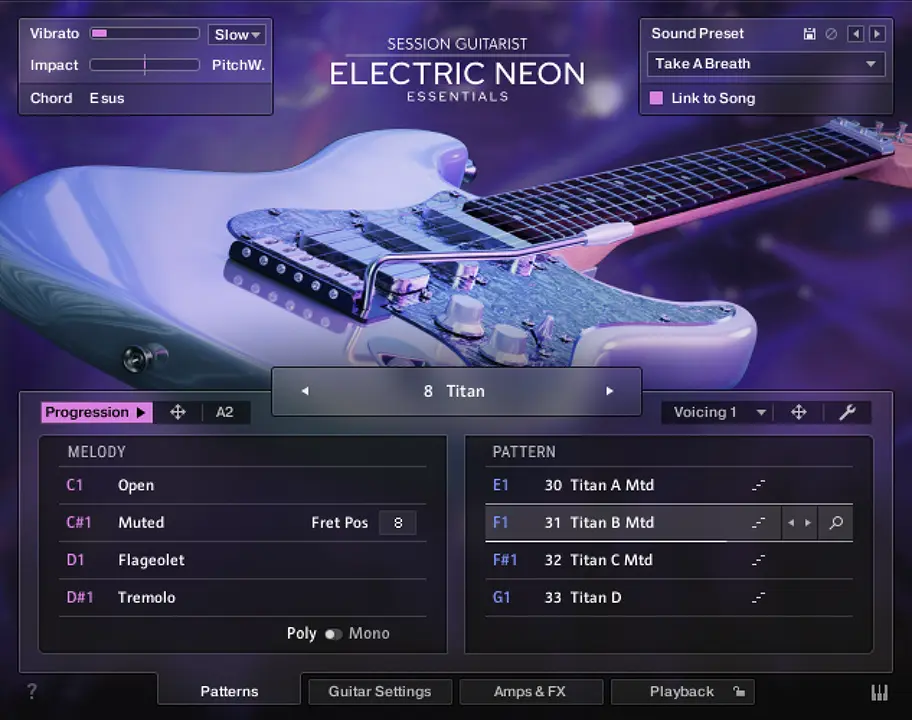
- Product: Session Guitarist – Electric Neon Essentials
- Publisher: Native Instruments
- Version: 1.0.0
- Requirements: Kontakt v8.7.2 or later
- Source: native-instruments.com/guitar/session-guitarist-electric-neon-essentials/
Session Guitarist – Electric Neon Essentials is a pattern-based guitar instrument plugin by Native Instruments designed to deliver mix-ready pop and EDM guitar parts without requiring traditional guitar playing skills. It features 148 pre-recorded patterns, 31 curated sound presets, and a dedicated melody mode, powered by samples from a custom Stratocaster-style guitar with active EMG pickups. Designed for producers working in electronic, pop, and dance music, it solves the problem of quickly adding professional guitar textures that sit perfectly in a digital mix without extensive tweaking.
Key Takeaway
Electric Neon Essentials is a fast-entry guitar tool that excels at delivering radio-ready electric guitar textures through its pre-dialed sound design, particularly for producers who need electronic-music-appropriate guitar within minutes, not hours. With 148 tempo-synced patterns and 31 polished presets built around modern effects, it’s an excellent choice for pop and EDM producers, especially those without guitar skills or a quiet recording space. At $79, it’s the most affordable entry into the Session Guitarist ecosystem.
Processed, Not Raw
Electric Neon Essentials is positioned against the entire Session Guitarist philosophy—but with an electronic music lens. Unlike Electric Vintage (1950s-style Fender tones) or Electric Sunburst (bright, articulate classic rock), this instrument makes no apologies for being a sound design tool wearing a guitar shape. The sample source is technically a Strat-inspired guitar (Kramer body, Tom Anderson neck, Floyd Rose tremolo, Schecter tuning pegs, active EMG pickups), but the moment you load a preset, the recording chain gives it away: UA 2-610 preamp, ribbon microphone, Neve 1073 channel strip, external rubidium atomic clock for precision. Every pattern comes pre-EQ’d, pre-compressed, and pre-effected. There’s no “raw DI” mode buried in menus—the DI signal exists only to be blended with the microphone signal for tonal sculpting, not to serve guitar purists.
This is intentional. The marketing line is “mix-ready.” What that actually means: you load a preset (Shimmer Synth, Disco Pulse, Neon Drive, etc.), hit play, and it’s already occupying its frequency space correctly. No hours of EQ tweaking to carve it into the mix. The 30 hand-crafted amp and effects chains are curated, not infinite. You get depth through presets, not parameter maximalism.
Two Instruments, One Vision
Electric Neon Essentials ships with two playable instruments: Pattern Engine (rhythm) and Melody Mode (leads). The Pattern Engine is where the value lives.
The Pattern Engine. You select from 148 patterns organized by tempo, style, and energy. Patterns include fast syncopated grooves, rolling 16ths, swells, triplets, and dynamic accents—all performed live by session guitarists Christoph Bernewitz, Joschi Joachimsthaler, and Jonas Roßner. Each pattern is tempo-synced to your DAW, and you can adjust loop length, groove feel, and humanization (swing) via the Pattern Inspector. The most useful feature: drag-and-drop MIDI export. Select a pattern, drag it into your DAW’s piano roll, and you get the MIDI as data. This is critical. It means you can edit patterns, combine them, or use them as starting points without being locked to the sampled rhythm.
Patterns live across 31 song presets. Each song preset bundles four to eight related patterns (Common Phrases for connectivity + Style Phrases for variety). In practice, this means you can load “Indie Pop” and get four complementary rhythm variations that actually work together, rather than assembling them yourself. The keyswitch layout is intuitive: light-colored keys trigger patterns, red keys trigger variations, purple keys signal phrase endings. This is borrowed from the entire Session Guitarist family and proves itself in real sessions.
The Melody Mode. The second instrument is built for lead lines, solos, and melodic fills. It offers articulations (open, muted, flageolet, tremolo) across nearly four octaves, with multiple velocity layers and round-robin variations to avoid sample repetition. You can layer melody mode over pattern mode—hold a pattern, then play solo lines on top. The poly/mono toggle lets you play chords if you want to. However—and this matters—melody mode is simpler than what you get in UJAM’s offerings or dedicated monophonic synths. It’s not designed to emulate every nuance of fingerstyle technique. It’s designed to give you playing-surface access to the melodic content quickly. If you need nuanced bending, finger slides, and articulation complexity, this isn’t your tool.
The Sound: Bright, Processed, Intentional
A custom Strat with active EMGs recorded through a ribbon mic will never sound “vintage.” Electric Neon knows this. The tone philosophy is three things: (1) clarity in the high-mids and presence region, (2) active pickup aggression, (3) lush, spacious effects.
The 31 presets are categorized by effect type: DI (minimal processing, for amp sims elsewhere), Clean (bright, polished), Crunchy (light overdrive), Modulation (chorus, flanger, phaser), and Spacious (reverb, delay, wide). Each preset can host up to 24 effects, pulling from NI’s Kontakt effects library (amp emulations, EQ, reverbs, tape saturation, compressors, etc.). The curated effects chains sit inside the mix correctly because NI’s team dialed them in for electronic-music frequency balance. This isn’t a mistake—it’s the whole point. You get “Shimmer Synth” (lush, wide, glassy), “Disco Pulse” (tight, punchy, driven), “Neon Drive” (overdriven, present, cut-through). Each one is a complete tone package.
There’s a blend knob for DI vs. Microphone signal. This lets you adjust character: more DI = tighter, cleaner; more mic = spacious, roomy, atmospheric. In a dense EDM mix, you’d probably favor DI with subtle mic blending. In a sparse pop track, you might invert that ratio.
CPU and Technical Fit
Electric Neon runs in Kontakt 8.5.0+ (free Kontakt Player works). Download is 18.3 GB. System requirements are standard: OpenGL 2.1+ graphics, 4GB RAM minimum (6GB recommended for large Kontakt libraries). CPU load is moderate—expect 4–8% on a typical DAW for a single instance, scaling with effects density. It’s NKS-compatible (Native Kontrol Series), meaning it integrates with Kontrol keyboards and displays key ranges, articulations, and keyswitches on the Light Guide. This is valuable for live play, though most producers use it in the DAW. Drag-and-drop pattern export works in all major DAWs (Logic, Cubase, Ableton, Reaper, Studio One).
One technical note: patterns are velocity-sensitive within the instrument, but once exported as MIDI, you control velocity in your DAW. This matters because if you export a pattern and want to subtly adjust its dynamics, you can. If you want to keep the recorded dynamics locked in, use Kontakt’s quantize and note-off length controls before exporting.
Pros & Cons
Pattern count vs. breadth. 148 patterns is solid, not massive. Electric Storm Deluxe has 270. If you need 200+ rhythmic variations across multiple genres and tempos, Electric Neon is narrower. However, with drag-and-drop MIDI, you can export patterns, duplicate them, and manipulate them in your DAW, so the actual creative flexibility is higher than the number suggests.youtube
Single guitar tuning. All patterns and melody samples are locked to standard tuning on a Strat-style guitar. If you need alternate tunings, baritone guitars, or microtonal exploration, this isn’t your tool. The Session Guitarist series each targets one instrument, one tuning. Electric Neon is no exception.
Melody mode is not a virtuoso tool. You get open, muted, flageolet, and tremolo articulations. You don’t get tapping, harmonics beyond flageolets, string-by-string control, or the kind of playing-surface complexity that would let you emulate fingerstyle technique closely. If you’re scoring film and need authentic guitar technique emulation, use a detailed synth-voice library or record the parts yourself. Electric Neon prioritizes speed and electronic-music integration over technique depth.
Limited sound-design depth. You have 24 effects per preset, but you’re constrained to Kontakt’s built-in effects rack. If you want LFO modulation on specific parameters, per-track sidechain compression, or advanced synthesis, you’d route the MIDI to a synth and stack effects in your DAW instead. The presets are designed to be finished sounds, not starting points for heavy sound design.
| Pros | Cons |
| Mix-ready presets sound professional immediately; no tweaking required to sit in modern pop/EDM mixes | Single guitar tuning; can’t access alternate tunings or baritone voicings |
| Fast workflow: load preset, play pattern or melody, export MIDI—all within seconds | Melody mode lacks articulation depth; not designed for virtuosic technique emulation |
| Affordable entry point ($79); cheapest Session Guitarist option | 148 patterns is solid but modest compared to competitor breadth; requires DAW to multiply variations |
| Drag-and-drop MIDI export unlocks pattern editing and combination in your DAW | Effects chains are Kontakt-only; limited advanced sound design customization |
| Intuitive keyswitch design and Pattern Inspector; shallow learning curve for beginners | Community is early-stage; minimal peer support and shared presets yet available |
| Ideal for electronic music producers without guitar skills or recording space | Designed specifically for pop/EDM; not optimal for traditional rock or classical composition |
| NKS-compatible with Kontrol keyboards; integrates seamlessly into DAW-based workflows | Pricing will likely increase post-intro; current $79 may jump to $119–129 |
What It Does Better Than Competitors
Preset curation. UJAM’s Icon Bass and Amber 2 guitars give you breadth (100+ patterns, multiple playing styles). NI’s Session Guitarist series gives you depth per preset. Electric Neon has 31 hand-dialed sound presets. This is tight. Each one works. You won’t find yourself scrolling endlessly. This is intentional design philosophy.
Modern production bias. Electric Storm Deluxe (the metal sibling, 8-string, 270 patterns, £129) is cinematic and heavy. Electric Neon is electronic music first. The effects, the EQ curves, the reverb tails—they’re optimized for pop, EDM, and synth-forward production. If you’re building a Hyperpop track or a dance anthem, this lands quicker than trying to tame a vintage-focused instrument.youtube
Drag-and-drop MIDI workflow. The MIDI export feature is genuinely elegant. You can build rhythmic beds in Kontakt, export the pattern, then manipulate it in your DAW. This is faster than entering patterns note-by-note and more flexible than being locked to playback.
Price. At $79, it’s the cheapest entry into the Session Guitarist lineup. Electric Storm Deluxe’s intro pricing starts at £4 (roughly $5), but the permanent price is £129–150. Electric Neon at $79 might increase post-launch (following the pattern of previous releases), but it’s competitive with UJAM’s entry-level offerings and significantly cheaper than dedicated guitar amp sims like Guitar Rig Pro.
Final Verdict
Electric Neon Essentials is a specialist tool masquerading as a generalist. It does one thing extremely well: deliver chart-ready electric guitar textures for modern pop and electronic music production. If you’re making EDM, hyperpop, synthwave, or Disco House, and you need guitar parts that sit in your mix without endless tweaking, this is a top-tier choice. The price is low, the presets are professional, and the drag-and-drop workflow integrates seamlessly with DAW-based production.
If you’re a traditional guitarist exploring composition, a rock producer, or someone who values instrument authenticity and technique depth, the other Session Guitarist variants (Electric Sunburst, Electric Vintage) are better choices. This tool is unapologetically electronic-music-centric. It’s not a compromise—it’s the point.
For producers working in the genres it’s designed for, Electric Neon Essentials is an easy yes at $79. Watch the price post-launch; if it jumps to $119–129 like its siblings, the value proposition shifts slightly toward “very good” rather than “excellent.” But as it stands, it’s a smart, fast, and effective tool for modern production workflows.
Rating: 4.15 / 5 — Strongly Recommended for electronic and pop music producers.
FAQs
-
How does Electric Neon compare to UJAM’s Icon Bass or Amber 2 guitar?
UJAM instruments emphasize playing flexibility and preset breadth. Native Instruments emphasizes sound curation and modern production workflow. UJAM presets are often “blank canvas” starting points; NI presets are finished sounds. If you like tweaking and designing from presets, UJAM is more flexible. If you want to load and play, NI is faster. Electric Neon’s MIDI drag-and-drop and melody-mode keyswitches feel more immediate. Price-wise, they’re similar ($79–99), but Electric Neon has more effects depth per preset.youtube
-
Does Electric Neon replace Electric Storm Deluxe or Electric Sunburst?
No. Electric Storm Deluxe is for metal and cinematic rock (8-string, 270 patterns, heavy processing). Electric Sunburst is for classic rock brightness. Electric Neon is for electronic music. They target different genres and moods. If you’re making pop or EDM, Electric Neon is the right choice. If you’re scoring dark metal or retro-rock, choose Storm or Sunburst respectively.
-
Can I use this without Kontakt? Does the free Kontakt Player work?
Yes, the free Kontakt Player 8.5.0+ works. You don’t need a Kontakt license. Just download the free player from Native Instruments’ website, install Electric Neon, and play. This is a major advantage for cost-conscious producers.
-
How realistic does this sound compared to a real guitarist?
It’s obviously sampled, not a real guitarist. The patterns are performed by session musicians, so the phrasing feels human—swing, timing variation, dynamics are preserved. But it’s processed through modern effects chains, so it sounds like “guitar in a pop production,” not “a guitarist in a room.” If you’re layering it with other synths and drums in a dense mix, no one will notice. If it’s a solo spotlight requiring virtuosic technique, they will.
-
Does this work with hardware controllers like Elektron or hardware sequencers?
Electric Neon is Kontakt-based, so it lives in your DAW. You can use MIDI controllers (keyboards, step sequencers) to trigger patterns and play melody mode, and NKS integration works with Kontrol keyboards. But it’s not designed for standalone hardware workflow. If you’re working exclusively with hardware, this isn’t the right tool.
-
Will the price increase after launch?
Based on precedent, likely yes. Electric Storm Deluxe’s intro pricing was £4; permanent price is £129. It’s likely Electric Neon will increase from $79 to $119–129 after the intro period ends. If you’re on the fence, buying within the intro window makes financial sense.
-
Can I export the patterns and use them in other plugins?
Yes. Drag-and-drop exports the pattern as MIDI data. Once it’s MIDI in your DAW’s piano roll, you can use it with any other instrument—synths, drum plugins, even other guitar tools. The pattern data is unlocked; the samples are not.
-
How much CPU does this use?
A single instance typically uses 4–8% CPU depending on effects density and your system specs. Two instances might push 12–16%. It’s moderate and not a concern on modern systems, but it scales with complexity. Turning off reverb and excess effects reduces load further.
Native Instruments Session Guitarist – Electric Neon Essentials [KONTAKT]
Session Guitarist – Electric Neon Essentials is a pattern-based guitar instrument plugin by Native Instruments designed to deliver mix-ready pop and EDM guitar parts without requiring traditional guitar playing skills. It features 148 pre-recorded patterns, 31 curated sound presets, and a dedicated melody mode, powered by samples from a custom Stratocaster-style guitar with active EMG pickups. Designed for producers working in electronic, pop, and dance music, it solves the problem of quickly adding professional guitar textures that sit perfectly in a digital mix without extensive tweaking.
Price: 79
Price Currency: EUR
Operating System: Windows, macOS
Application Category: Multimedia
4.1