
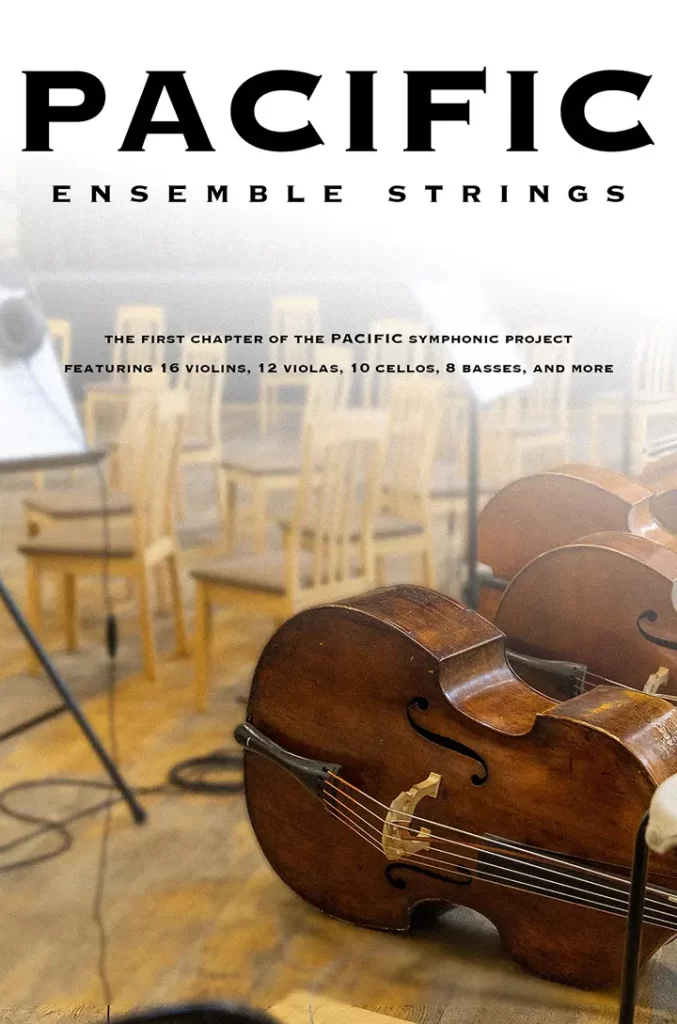
- Publisher: Performance Samples
- Product: Pacific Ensemble Strings
- Requirements: Kontakt v6.6.0 or higher
Pacific – Ensemble Strings is a symphonic string library featuring 16 violins, 12 violas, 10 cellos, 8 basses, a solo harp, and a 3-violin FFF overlay. It is one part of the full PACIFIC orchestra (ensemble strings, solo strings, brass, woodwinds, and percussion). The library – featuring up to 14 dynamics – offers an ambient, classical-leaning sound in standard orchestral seating position, and was recorded in the same room as Fluid Shorts 2, as well as the Con Moto series, Caspian, and the original Fluid Shorts.
Articulations
From the very beginning, the idea with this project was a symphonic string solution offering a variety of common articulations in one package which would be fairly general-purpose as opposed to specialized. The strings have a rather comprehensive articulation list but are also lacking in terms of things like multiple variations of arco shorts and somewhat more esoteric articulations (sul pont trem, col legno, etc). The PACIFIC orchestra was originally just strings, with the brass/woodwinds/brass/solo strings recorded later on to fill out the other orchestral sections (and they are not quite as comprehensive, but still offer a strong “meat-and-potatoes” collection and some other features).
Aside from more common articulations, there’s some exploration of small variations on traditional articulations, such as marcatos with short, phrase-sourced RR releases capable of staccato-esque phrases (kind of like Angry Brass Pro), and whisper sustains (soft, quasi-harmonic/sul tasto with a dynamic range).
Dynamics
There’s no particular dynamic bias in this library. It wasn’t about making a library constrained to ultra-aggressive or extraordinarily delicate and soft; but rather making a library capable of both, and everywhere in between. Ample session time helped accomplish this, yielding a significant dynamic range throughout the library. It’s an interesting experience playing a string patch with a very large recorded dynamic range, with particular attention afforded to the delicately distinct shades of the f-ff region, allowing the accessibility of a rather thematic, strong timbre that doesn’t have the abrasion of the highest FFF higher up on the mod-wheel. Although it’s just one part of the mockup puzzle, it does open up some new doors in terms of programming nuance.
Performance
The library employs performance-sourced/repetition sampling heavily, and while there was certainly extra attention and focus on the legatos, there is generally nothing groundbreaking going on in terms of new sampling approaches. It’s rather about honing in on some historically-successful PS approaches (and/or variations of) with a group of concentrated musicians. The library generally leans away from super quirky or wildly experimental in terms of approach. There will be other projects for that in the future.
Room
The sound of this library is decidedly symphonic and classical. There is a somewhat homogeneous quality to it, in part due to the ensemble size, but also due to a lack of over-the-top vibrato (although this is rather subjective). The mic setup is straightforward: an AB pair and then stereo close mics per section. It’s not an extraordinarily detailed sound, but the wash of ambience is counterpointed by rather spirited performances and very consistent editing. Attention was paid to accurate session recall in terms of maintaining the main mics balance and position between sessions to retain a natural balance.”
Consistency / Playability
The creative emphasis of overall consistency lends itself to a rather predictable nature in terms of moving between dynamics and general function. Despite the larger ensembles, the performance-sourced approach used here has the tendency to stabilize the players regardless of the size of the group, especially with repetitions for short notes as there’s less room for timing interpretation with a faster paced score configuration.
There was also a lot done in terms of smoothing out mod-wheel and velocity function while keeping actual recorded dynamic volume and timbre in mind — a delicate balance and ongoing aim in development. The shorts have control over the sample “pre-delay” time, in conjunction with layered, under-the-hood script overrides for optimizing ambience in the attacks and “dynamic no-follow” subtleties on accented notes. Overall, the library certainly still requires sensitivity to the sample content in terms of mockup decision-making, but the general idea is for things to play rather intuitively once you familiarize with the library.