
- Product: Bad Channel
- Publisher: Dog Magic
- Version: 1.0.0
- Format: VST3, AU
- Requirements: Windows 7 or later, macOS 10.11 or later
- Source: https://dogmagic.net/bad-channel/
Dog Magic Bad Channel is a multi-effect channel strip plugin that combines distortion, wide modulation (chorus/flanger), broken comb filtering, tape-machine delay, and resonant EQ into a single “nightmare” processor. It includes dual-channel distortion with independent input/output gain control, width-controlled modulation with feedback, a frequency-dependent broken comb effect with a “Magic” button, parametric filtering (low-pass and high-pass), sketchy delay with feedback, and a real-time frequency analyzer. Designed for lo-fi producers, experimental sound designers, and anyone seeking intentional sonic degradation, it addresses the need for creative destruction and character-building in a compact, affordable package without compromise.
Key Takeaway
Bad Channel is for people who want their sound to be worse in interesting ways—it’s a celebration of lo-fi aesthetic, aliasing, and sonic weirdness packed into controls that feel playable rather than painful. For lo-fi, experimental, and intentionally-degraded production, it’s essential; for transparent mixing, keep walking.
The “Nightmare” Philosophy: Destruction as a Feature
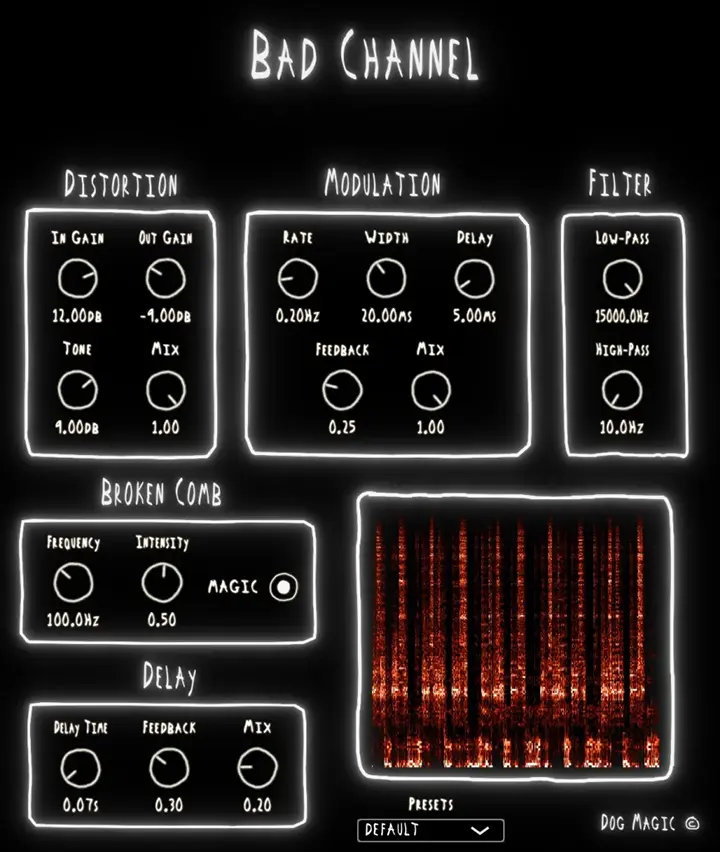
Dog Magic positions Bad Channel as “the affordable multi-fx channel strip plug-in of your nightmares.” This framing is intentional and honest—this is not a tool for pristine sound, surgical EQ, or transparent signal processing. It’s a tool for intentional sonic sabotage. The interface itself—neon glowing knobs, a spectrogram visualizer, sparse labeling—signals that you’re in lo-fi territory.
The combination of features (distortion, modulation, broken comb, delay) is designed to work together to create that characteristic lo-fi sound: compressed, characterful, deliberately degraded, yet somehow musical.
Distortion: Foundation and Personality
The distortion section offers independent input and output gain control—this is the core tone-shaping tool. Cranking input gain adds aggression and drives the signal into dirt; backing off output gain controls the final level without sacrificing character. This is accessible but has depth: you’re not just turning a “drive” knob, you’re understanding gain-staging within a degradation circuit.
The Tone control (shown as 4.00dB in the interface) suggests passive EQ-style coloration—likely a tilt control that boosts one end while cutting the other. This is characteristic of cheap, lo-fi audio equipment, so modeling it here is intentional.
Modulation: Wide, Weird, Unapologetic
The modulation section (Rate, Width, Delay, Feedback, Mix) is deliberately broad—this isn’t surgical LFO modulation, it’s uninhibited chorus/flanger weirdness. The Width parameter suggests phase/comb effects; the Delay and Feedback parameters enable resonance and self-reinforcement that creates that “washing” quality of heavily modulated lo-fi sources.
This is where Bad Channel separates from clean channel strips. This modulation doesn’t enhance clarity; it obscures it, in the best possible way.
The free Bad Channel Micro module (available separately) extracts just this modulation/chorus/flanger capability, confirming it’s considered a standout feature worth offering independently.
Broken Comb: The Cryptic Secret Weapon
The “Broken Comb” section (Frequency: 100Hz, Intensity: 0.50, with a “MAGIC” button) is where Dog Magic gets genuinely creative. Comb filtering traditionally refers to phase-interference effects where delayed signals cancel and reinforce at regular frequency intervals, creating that distinctive “washing” sound. “Broken” suggests intentional degradation or randomization—the effect is not clean phase-alignment, it’s phase misalignment.
The Frequency parameter targets where this comb effect occurs; Intensity controls prominence. The MAGIC button (function undocumented in available materials) likely introduces randomization, automation, or an additional processing layer that makes the comb effect unstable and unpredictable. This unpredictability is the lo-fi appeal—authenticity through imperfection.
Delay: Sketchy Feedback Machine
The delay section has independent Delay Time (0.07s default), Feedback (0.30), and Mix (0.20) controls. The Feedback parameter is elevated, enabling self-reinforcing echoes that build texture rather than simple rhythmic repeats. The Mix defaults to 20% wet, suggesting this is supplementary, not dominant. But turning Feedback up creates resonant, almost metallic trails—appropriate for lo-fi production where ambiguity and decay are desirable.
The “sketchy tape-machine delay” description suggests analog emulation characteristics (wow, flutter, saturation), though none of that is explicitly visible in the interface. The effect likely emerges from distortion and modulation feeding into the delay.
EQ: Minimal But Intentional
Low-pass at 15kHz and High-pass at 10Hz are broad, gentle filters—not surgical, but definitely present. These aren’t the standard ±20kHz boundaries; they’re deliberately tightened to remove some presence and sub-bass. This is coloration, not transparency.
Playability Over Complexity
The interface features a spectrogram analyzer showing frequency content in real-time. This isn’t for surgical frequency work; it’s visual feedback. You turn knobs, the spectrogram updates, you hear (and see) the degradation happening in real-time.
The control layout groups related functions in logical boxes—Distortion, Modulation, Broken Comb, Delay, Filters—without overwhelming parameter count. You’re choosing between playable options, not tweaking 47 individual settings. This positions Bad Channel as fast and explorable rather than deep and overwhelming.
Pros & Cons
| Pros | Cons |
| Broken Comb + Modulation are genuinely unique sonic tools for lo-fi creation. | Intentionally degrading; useless for transparent, clean mixing. |
| Fast playability: load, turn knobs, get character immediately. | “MAGIC” button and full Broken Comb behavior requires discovery through trial. |
| Free Bad Channel Micro (modulation module) enables exploration without cost. | Limited documentation visible in available materials; learning-by-doing. |
| Affordable pricing positions this as accessible to home producers. | Niche appeal; not useful for mixing engineers, mastering, or traditional genres. |
| Spectrogram visualizer provides immediate visual feedback on frequency impact. | CPU usage and stability not documented in available info. |
| Multi-effect bundling reduces plugin-slot overhead in lo-fi production chains. | Best suited to lo-fi contexts; poor fit elsewhere. |
FAQs
-
Is Bad Channel designed specifically for lo-fi hip-hop production?
Yes. The combination of distortion, modulation, broken comb, and delay is explicitly designed for that aesthetic. Load it on drums, synth loops, or samples—turn the dials and you get that signature lo-fi wash. This is Bad Channel’s primary use case and where it excels.
-
How does Bad Channel compare to other lo-fi tools like RC-20 Retro Color or Soundtoys Decapitator?
Different philosophies. RC-20 is a tape/vinyl/noise suite optimized for vintage degradation. Decapitator is a saturation/distortion specialist with surgical control. Bad Channel bundles multiple lo-fi tools (distortion, modulation, broken comb, delay) into one processor, prioritizing instant playability and character over depth in any single effect. Want a complete lo-fi sound in one plugin? Bad Channel. Want deepest distortion control? Decapitator. Want vintage tape emulation? RC-20.
-
Can I use Bad Channel on a full stereo mix, or should it stay on individual tracks?
Individual tracks. Broken Comb and heavy Modulation easily muddy a stereo field; Distortion affects dynamic range unpredictably. Use it surgically on drums, loops, or synths where intentional degradation enhances the aesthetic. On a stereo bus, risk is homogenizing everything into unusable mud. Design suggests tracks, not buses.
-
What does the undocumented “MAGIC” button do?
Not explicitly explained in available materials. Likely introduces randomization, automation, or an additional processing layer to the comb effect, making it unstable and unpredictable—consistent with the “nightmare” aesthetic. Discovery through experimentation is part of the appeal and philosophy.
Final Verdict
Bad Channel is a lo-fi specialist’s dream and everyone else’s nightmare. It’s uncompromising in its approach: distortion, weirdness, and degradation are the point, not side effects to be minimized. The broken comb filtering is genuinely unique; the modulation is deliberately uninhibited; the distortion is unapologetic.
For lo-fi hip-hop, experimental production, and anyone building a sound that wants to be lo-fi, Bad Channel delivers instantly and affordably. For mixing engineers, traditional producers, or anyone seeking transparency, this is the wrong tool entirely.
The affordability and free Micro module mean barrier to exploration is low. The playable interface means you spend time creating, not menu-diving. The spectrogram feedback means you see what you’re doing in real-time.
Bad Channel doesn’t hide what it is. It’s a nightmare multi-fx designed for intentional destruction. If that’s what you want, it’s exceptional.
Rating: 4.4 / 5
Exceptional lo-fi multi-effect combining unique sonic tools (broken comb, wide modulation) with instant playability and affordable pricing. Intentionally degrading; completely inappropriate for transparent mixing. Niche positioning limits universal appeal. For lo-fi, experimental, and creative destruction, highly recommended.
Dog Magic Bad Channel
A multi-effect channel strip plugin by Dog Magic featuring distortion, wide modulation (chorus/flanger), broken comb filtering, tape-machine delay, and parametric EQ. Includes spectrogram analyzer, independent input/output gain control, Broken Comb frequency-dependent effect with MAGIC button, and real-time visual feedback.
Price: 20
Price Currency: USD
Operating System: Windows 7, macOS 10.11
Application Category: Multimedia
4.4