
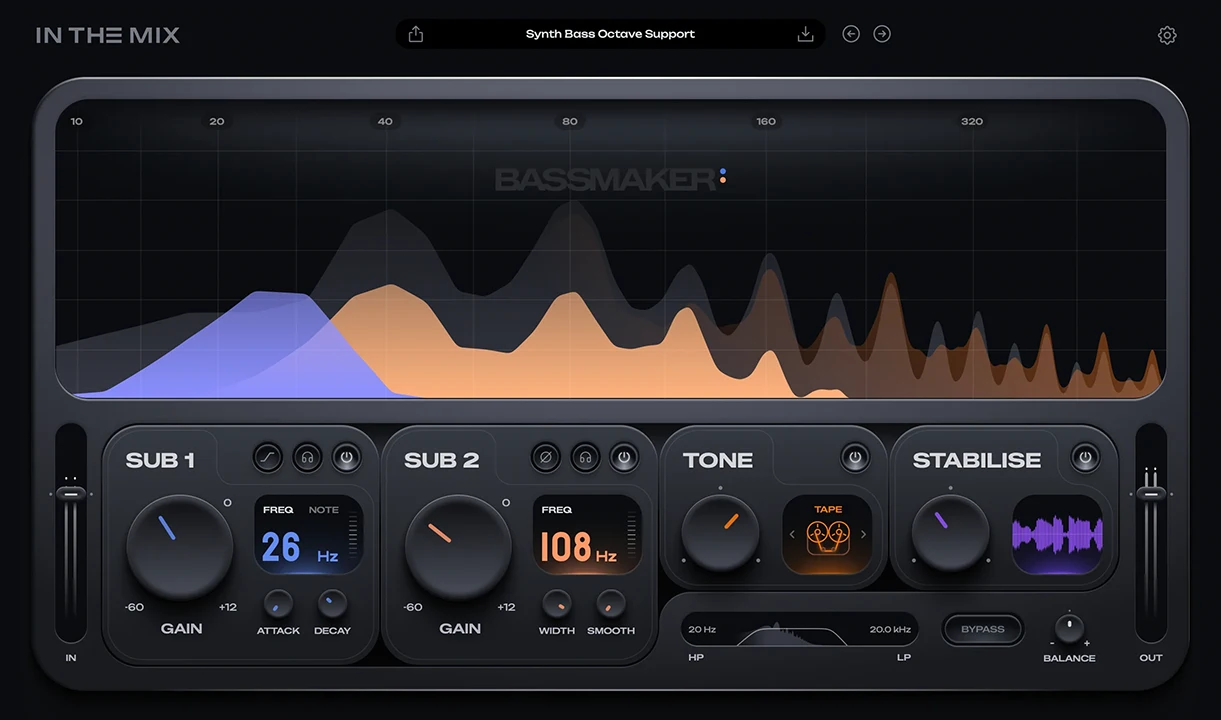
- Product: Bassmaker
- Developer: In The Mix
- Version: 1.0.1
- Format: VST3, AAX
- Requirements: Windows 10 or later
- Source: inthemix.store/products/bassmaker
Bassmaker is a subharmonic generator plugin combining two independent bass-synthesis engines — SUB 1, a static fundamental tone locked to a fixed note or frequency, and SUB 2, a pitch-tracked lower-octave generator — with a low-focused spectral compressor and a tube/tape saturation stage. It sits on individual tracks where it generates or reinforces sub content below the source signal’s own fundamental, rather than adding harmonics above it the way exciter-style bass-enhancement plugins work. Its differentiator is the two-engine split: SUB 1 handles static reinforcement at a fixed pitch while SUB 2 tracks the input and generates a pitch-following octave below it, allowing both functions in one instance at independent gain levels. For anyone searching for a plugin that creates actual sub-bass from a source with no low end rather than one that enhances existing bass through harmonic generation, this is that plugin.
Key Takeaway
Activates when a track needs genuine sub-bass added below its existing content — a kick lacking fundamental weight, a bass guitar that needs an octave below its recorded range, a vocal or synth being repurposed for bass reinforcement in a section. Displaces harmonic-exciter plugins that add perceived bass by layering upper harmonics rather than generating a lower fundamental. Doesn’t currently compensate correctly for latency at sample rates above 48kHz in VST3 format on at least Bitwig and FL Studio — a confirmed, unresolved bug at the time of writing that makes the plugin unsuitable for engineers working at 88.2 or 96kHz until a fix ships.
SUB 1: Static Fundamental at a Fixed Pitch
SUB 1 generates a bass tone locked to a user-selected note or frequency rather than tracking the input signal’s own pitch, with an envelope follower whose attack and release control how the generated tone follows the input signal’s dynamics. The developer’s own recommendation is to leave attack at its fastest setting and only increase it for deliberately delayed or grooved sub effects — a practical tuning note that reflects how the module responds: faster attack gives tighter tracking of transient onset, while slower attack delays the sub’s entry relative to the input hit.
The decay control shapes how long the generated tone sustains after the input signal drops, with the manual explicitly noting that extremely fast decay settings can introduce additional harmonics into the generated signal — a real, stated artifact risk that emerges specifically at the short-decay end of the range rather than being a byproduct of heavy gain. This makes decay a control that affects both timing and character rather than only timing, and it’s worth auditioning on the spectrum display rather than setting by number alone.
SUB 2: Pitch-Tracked Lower Octave With Three Quality Modes
SUB 2 generates an octave-lower pitch-tracked signal from the input, with a centre frequency target and adjustable detection bandwidth (Width) that determines how broadly the pitch-tracking circuit scans the input before generating its output. Wider bandwidth produces a more natural-sounding result on most material; narrower bandwidth is more precise but harder to blend, particularly on sources where pitch changes quickly or unpredictably. A dedicated smoothing control applies a custom algorithm to the generated signal, with the manual flagging that fully-off smoothing works better on fast, transient-heavy material while higher smoothing values suit sustained notes.
Three quality modes — High Quality, Balanced, and Efficient — each use a different pitch-detection and generation algorithm with distinct CPU costs. High Quality uses significantly more processing than either alternative, which the developer notes directly rather than implying all three modes are equivalent in resource use; on older hardware, Balanced or Efficient in combination with careful monitoring is the stated recommendation. SUB 2’s centre frequency currently tops out at around 120Hz, a design ceiling the developer confirmed when asked whether the upper limit could extend to 150–160Hz to better support snare fundamentals — the response was hesitation about extending beyond sub range, leaving snare-body reinforcement at the boundary of what SUB 2’s detection range currently covers.
Stabilise and Tone: What Each Module Actually Processes
Stabilise is a spectral compressor acting specifically below 150Hz, functioning as a low-end leveler that evening out both the incoming signal’s bass content and the generated SUB 1 and SUB 2 output simultaneously. The Amount control effectively acts as a threshold — turning it up lowers the threshold and applies make-up gain proportional to the gain reduction applied — though the developer acknowledges the make-up gain is program-dependent and may not perfectly match perceived volume, making the output gain control necessary for final balance calibration by ear.
Tone applies tube and tape saturation to both the input signal and the generated bass together rather than to the generated signal alone, which keeps the saturation character cohesive between the source and what Bassmaker has added beneath it. This matters most when the input and generated signals are blended at similar levels — applying saturation to only the generated bass would create a tonal mismatch between the source’s clean character and the added sub’s saturated one, while running Tone across both keeps the relationship consistent. Oversampling for the Tone module is available as an opt-in setting in the plugin’s settings panel, off by default.
The 96kHz Latency Bug and Current Sample-Rate Limits
Bassmaker does not correctly report or compensate for latency at sample rates above 48kHz in VST3 format, a behavior confirmed by multiple users running the plugin on Bitwig and FL Studio at 96kHz and acknowledged directly by the developer in the plugin’s launch-week Gearspace thread. The developer’s stated workaround is to use 44.1kHz or 48kHz sessions, where compensation “is bombproof,” while committing to a fix in the next update. No timeline for that update was specified in the thread.
This means the plugin is currently unsuitable for sessions running at 88.2 or 96kHz regardless of DAW, and engineers who routinely work at higher sample rates should wait for the fix before integrating Bassmaker into production workflows rather than relying on the available workaround. The bug is specific to latency reporting and compensation — it doesn’t imply audio-quality problems at 44.1 and 48kHz, where the plugin operates correctly per both the developer’s confirmation and user reports.
Genuine Sub Generation, Shipping With a Known Bug
Bassmaker creates actual sub content below the source’s own fundamental rather than reinforcing perceived bass through harmonics above it — a real distinction from most bass-enhancement plugins — but the 96kHz latency bug is developer-confirmed and unresolved in the current version, making the 14-day trial the right entry point for any engineer not already working at 44.1 or 48kHz.
FAQs
-
What’s the difference between SUB 1 and SUB 2, and do they need to both be active?
SUB 1 generates a static fundamental tone locked to a fixed note or frequency, with envelope following that tracks the input signal’s dynamics. SUB 2 pitch-tracks the input and generates a lower octave that follows the source’s own pitch movement rather than staying at a fixed point. Both modules can be used independently or together at different gain levels — deactivating either removes its contribution while the other continues processing. Most sources benefit from starting with one module and adding the other only if the result needs more complex reinforcement.
-
Does Bassmaker work at 96kHz sessions?
Not reliably in the current version — a confirmed bug causes incorrect latency compensation in VST3 format at sample rates above 48kHz, affecting at least Bitwig and FL Studio at 96kHz. The developer has acknowledged the issue and committed to fixing it in an upcoming update, with 44.1kHz and 48kHz sessions working correctly in the meantime. Engineers who work primarily at higher sample rates should use the 14-day free trial to verify behavior on their specific system and DAW before purchasing.
-
What does the Width control on SUB 2 actually change?
Width adjusts the bandwidth of SUB 2’s pitch-detection circuit — how broadly it scans the input frequency range before generating the lower-octave output. Wider settings capture more of the input’s frequency content and tend to produce a more naturally blending result; narrower settings are more precise but can be harder to integrate, particularly on fast or pitchy source material. The centre frequency control sets where in the spectrum the detection focuses, and Width determines how far from that centre the detection extends.
-
Does the Tone module add saturation only to the generated bass, or to the whole signal?
Tone applies tube or tape saturation to both the input signal and the generated bass output together rather than to the generated signal alone, keeping the saturation character consistent between the source and what Bassmaker adds beneath it. The developer notes this improves cohesiveness between the two signals. Oversampling for the Tone module is available as an opt-in setting in the plugin’s settings panel, disabled by default.
-
Can SUB 2 generate bass for snare reinforcement, or does it only work on sub-frequency sources?
SUB 2’s detection range currently tops out at around 120Hz centre frequency, a ceiling the developer confirmed during the plugin’s launch week when asked whether the range could extend to 150–160Hz to better cover snare fundamentals. The developer was hesitant to extend it beyond sub range in the current version, so snare-body reinforcement sits at the boundary of what SUB 2’s detection covers rather than clearly within it. Snare transient and upper-body content above that range is outside SUB 2’s current operating window.
In The Mix Bassmaker
Bassmaker is a subharmonic generator plugin combining two independent bass-synthesis engines — SUB 1, a static fundamental tone locked to a fixed note or frequency, and SUB 2, a pitch-tracked lower-octave generator — with a low-focused spectral compressor and a tube/tape saturation stage. It sits on individual tracks where it generates or reinforces sub content below the source signal's own fundamental, rather than adding harmonics above it the way exciter-style bass-enhancement plugins work. Its differentiator is the two-engine split: SUB 1 handles static reinforcement at a fixed pitch while SUB 2 tracks the input and generates a pitch-following octave below it, allowing both functions in one instance at independent gain levels. For anyone searching for a plugin that creates actual sub-bass from a source with no low end rather than one that enhances existing bass through harmonic generation, this is that plugin.
Price: 49
Price Currency: USD
Operating System: Windows 10
Application Category: Multimedia
4