- Product: Titan Tube Compressor
- Developer: Luxora Audio
- Version: 2.0.0
- Format: VST3, AAX
- Requirements: Windows 10 or later
- Source: luxora-audio.com/plugins/titan-tube-compressor
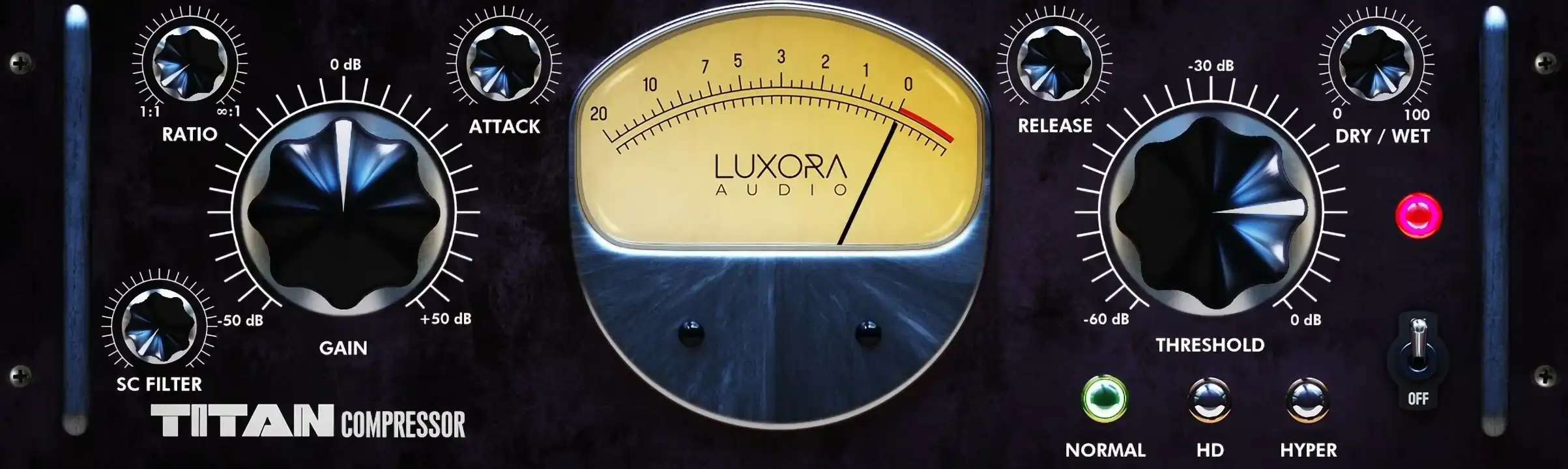
Titan Tube Compressor is a vari-mu compressor plugin mapped from a $7,000-class hardware tube unit, translating its gain-stage voltage response and transformer saturation curve into the Luxora Audio Hyper Technology Engine. It sits on mix-bus or track duty where transformer-driven density outweighs fast, aggressive gain reduction. Normal, HD, and Hyper model distinct voltage regions of the same circuit, not a wet/dry blend over one algorithm. A mix engineer chasing a thicker low end and a tighter stereo image on a two-bus pass reaches for this over a fast VCA compressor.
Key Takeaway
Titan activates on mix-bus or track passes where harmonic density and transformer glue matter more than fast peak control, displacing a VCA or FET compressor built for speed over color. It doesn’t catch hard peaks like a fast limiter, and stacking multiple instances across a chain compounds low-mid density quickly. Engineers running strict, transparent chains can skip it.
Coloration and Gain Reduction, Same Circuit
The gain stage and transformer core were mapped from the hardware’s own electrical behavior — voltage response of the tube stage, the magnetic saturation curve of the transformer, and the thermally driven harmonic output of the valves — then rebuilt inside the Luxora Audio Hyper Technology Engine. The saturation curve runs as a continuous function of signal level and dynamic content rather than a fixed harmonic overlay sitting on top of the gain reduction. Low end gains weight and depth, midrange gains energy and cohesion, and the top end picks up smoothing and air, all produced by the same transformer model rather than three separate filters.
Because harmonic content tracks signal level in real time, pushing a hotter signal into the plugin shifts the tonal balance the same way overdriving the original hardware’s input transformer would. A quiet pass and a hot pass through the same mode produce different amounts of low-end weight and top-end smoothing, not just different amounts of gain reduction. There’s no way to isolate gain reduction from harmonic coloration on this circuit — the modeled transformer ties the two together by design, with no clean or uncolored signal path underneath it.
Three Voltage Regions, No In-Between
Normal, HD, and Hyper aren’t density presets layered on one algorithm — each simulates a distinct voltage region of the tube circuit, carrying its own harmonic profile and transient character. Normal stays closest to a transparent pass, holding the source’s tone with minimal added color. HD moves the operating point up, adding moderate tube harmonics that make the compression’s character audible rather than just felt.
Hyper pushes furthest into the circuit’s operating range, producing the heaviest harmonic content and the strongest low-end and midrange push of the three. That mode also draws noticeably more CPU than Normal or HD, a real factor once several instances are running across a mix rather than one sitting on a two-bus. The three modes are discrete states rather than a continuous blend control, so moving between them is a step change in character, not a dial-in.
Built to Preserve Transients, Not Catch Peaks
Titan analyzes incoming material in the microseconds before it reaches the compression stage, using that window to shape how gain reduction responds to the source’s transient content. Instead of clamping down uniformly on every peak, the modeled circuit adjusts its response to preserve more of the attack shape as gain reduction increases. On material with strong transient definition — drum busses, plucked or picked sources — that shows up as retained punch even under heavier compression settings.
This pre-analysis approach is tuned for the smooth, program-dependent response vari-mu circuits are known for, not for fast peak-catching. Sources that need hard, instantaneous limiting — mastering ceiling control, transient peaks that need catching within a handful of samples — sit outside what this circuit topology is built to do.
A Two-Bus Circuit, Not a Peak Catcher
Harmonic density rises as gain reduction increases rather than the sound thinning out or turning brittle under heavier settings — the defining trait of vari-mu compression carried into the plugin. Pushing the compressor harder produces a fuller low end, more midrange cohesion, and a wider, more centered stereo image, without the transient smearing that shows up when a fast VCA or optical circuit gets driven past a few dB of reduction.
That density buildup is cumulative across a signal chain. Stacking Titan on individual tracks and again on the master risks over-thickening a source that’s already dense in the low-mids, since the same harmonic content compounds each time the plugin sits in the chain. One instance on the two-bus, rather than repeated instances per track, keeps that density from compounding into mud on a full mix.
The microsecond-scale lookahead behind Titan’s transient handling is tuned to shape a vari-mu circuit’s slow, musical gain-reduction curve — not to snap a limiter’s ceiling shut within a handful of samples.
FAQs
-
Does Titan Tube Compressor need an internet connection to run?
Activation and periodic license checks require an active internet connection during use, not just at installation. A machine that stays disconnected — an isolated tracking rig, an offline mastering room — can’t run the plugin without restoring that connection. That’s a different model from plugins built around a one-time offline authorization that never checks in again.
-
What formats and operating systems does Titan Tube Compressor support?
Mac support covers VST3, AU, and AAX on macOS 11 or later, running on Intel or Apple Silicon with 4 GB of RAM minimum. Windows support covers VST3 and AAX on 64-bit Windows 10 or later, with the same 4 GB RAM floor. CLAP isn’t listed for either platform, which matters for hosts built around that format.
-
How does Hyper mode affect CPU usage compared to Normal or HD?
Hyper draws noticeably more CPU than Normal or HD, since it simulates the circuit’s furthest operating region and produces the densest harmonic output of the three. On a session running several instances across a mix, that load becomes the practical ceiling before Normal or HD would. A single Hyper instance on a two-bus carries a smaller cost than the same mode duplicated per track.
-
Is Titan Tube Compressor still free, or does it require payment now?
Version 1.0.0 stayed free for six months after its original release. Version 2.0.0 moved to a paid model, currently listed at a $9.99 introductory price against a stated €99 regular price, with a 14-day trial available before committing. The introductory window is scheduled to close on August 4, 2026.
-
What parameters does Titan Tube Compressor expose for shaping compression?
Titan’s control point is mode selection across Normal, HD, and Hyper, each locked to a distinct voltage region of the modeled circuit. It doesn’t offer separately adjustable attack, release, ratio, or threshold controls the way a FET or VCA compressor typically does. The circuit’s own modeled response stands in for manual time-constant setting, mirroring the fixed behavior of the vari-mu hardware it’s built from.
Luxora Audio Titan Tube Compressor
Titan Tube Compressor is a vari-mu compressor plugin mapped from a $7,000-class hardware tube unit, translating its gain-stage voltage response and transformer saturation curve into the Luxora Audio Hyper Technology Engine. It sits on mix-bus or track duty where transformer-driven density outweighs fast, aggressive gain reduction. Normal, HD, and Hyper model distinct voltage regions of the same circuit, not a wet/dry blend over one algorithm. A mix engineer chasing a thicker low end and a tighter stereo image on a two-bus pass reaches for this over a fast VCA compressor.
Price: 9.99
Price Currency: USD
Operating System: Windows 10
Application Category: Multimedia
4
![Read more about the article Native Instruments FEEL IT [KONTAKT]](https://plugincrack.com/wp-content/uploads/2024/01/Native-Instruments-FEEL-IT-300x235.webp "Native Instruments FEEL IT [KONTAKT] 3 | Plugin Crack")