
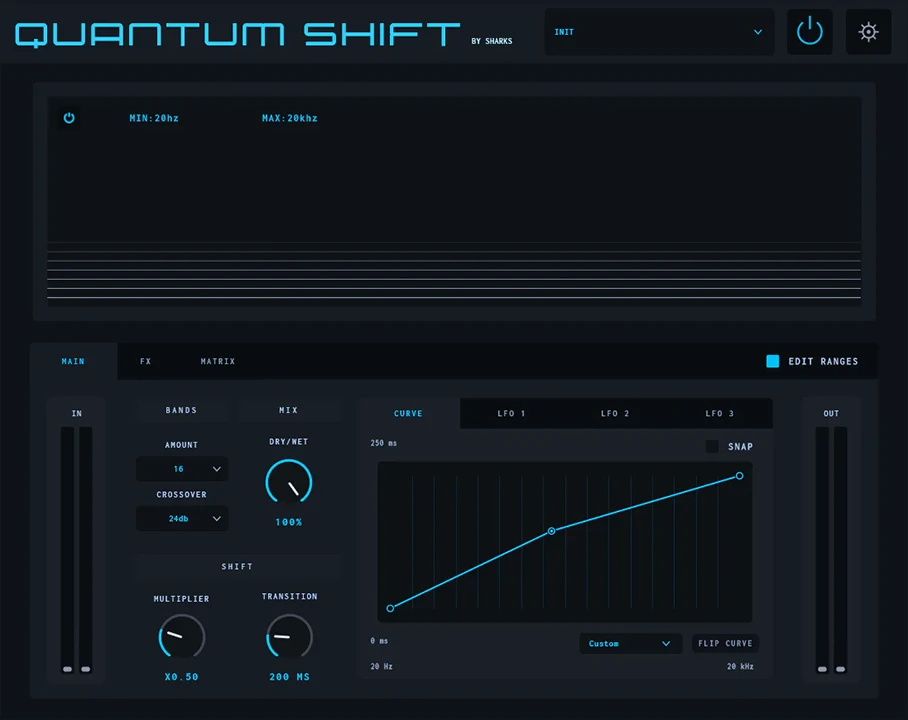
- Product: Quantum Shift
- Developer: Sharkstunes
- Version: 1.0.0
- Format: VST3
- Requirements: Windows 10 or later
- Source: sharkstunes.com/products/quantum-shift
Quantum Shift is a multiband delay and spectral time-shifting effect from Sharkstunes that splits incoming audio into 8–24 frequency bands and applies independently controlled delay offsets across the spectrum. Instead of producing conventional echoes, the plugin creates frequency-dependent pitch glides, dispersion-style movement, spectral smearing, and evolving time-domain textures. It occupies the sound-design layer of a session, particularly where static delays, chorus effects, and conventional modulation processors leave spectral motion largely untouched.
Key Takeaway
Quantum Shift becomes relevant when a signal needs movement across frequency bands rather than repetition across time. It complements delays, dispersers, frequency shifters, and modulation effects by introducing band-dependent timing relationships. Corrective mixing tasks, transparent processing, and conventional spatial enhancement rarely activate its strengths. Static production workflows may never encounter the conditions that justify its routing complexity.
Twenty-Four Delays Occupying Different Frequencies
Quantum Shift divides incoming material into as few as 8 or as many as 24 bandpass regions, each capable of receiving different delay treatment. The resulting signal develops spectral movement because low, mid, and high frequencies no longer arrive simultaneously.
Percussion, synth stabs, impacts, and transitions gain internal motion without requiring multiple layered processors. Frequency content appears to stretch, tilt, and unfold across time rather than remaining phase-locked to the original transient structure.
Dense harmonic material can become difficult to place inside traditional mix relationships. Signals carrying important rhythmic information may lose clarity when large timing spreads are introduced.
Delay Curves Instead Of Uniform Offsets
Each frequency band can receive timing assignments through customizable curve mapping. Delay distribution follows a programmable shape rather than a fixed linear progression across the spectrum.
The structural impact changes dramatically depending on curve geometry. One configuration may pull high frequencies forward while another may drag them behind the fundamental body of the sound, creating very different transient identities from the same source material.
Building useful curves requires experimentation. Producers expecting immediate preset-style results may spend more time shaping delay relationships than processing the source itself.
Pitch Movement Embedded Inside The Delay Path
Quantum Shift includes controls governing both delay time and the rate at which delayed material transitions in pitch. Frequency content can drift over time rather than remaining fixed at its original position.
The interaction between delay and pitch movement creates textures that sit somewhere between spectral processing, tape manipulation, and science-fiction sound design. Synth sequences, risers, impacts, drones, and cinematic effects gain evolving harmonic motion without requiring multiple dedicated processors.
Traditional pitch-correction or harmonization workflows fall outside the plugin’s scope. Producers seeking transparent transposition will likely reach for dedicated pitch-shifting tools instead.
Three Additional Processors Inside The Spectral Engine
Disperser, Compressor, and Delay modules can be inserted in different orders inside the processing chain. Spectral timing manipulation can therefore be combined with dynamics control and transient redistribution from within a single environment.
Layered effect chains become easier to audition because processor order can be changed without rebuilding a routing structure elsewhere in the session. Different placements produce noticeably different transient responses and spectral trajectories.
The available modules focus on supporting the core spectral-delay concept. Sessions requiring extensive corrective processing will still depend on external EQ, dynamics, and utility tools.
LFO Access To The Delay Architecture
Curve points, multipliers, and numerous internal parameters can be assigned to LFO modulation. Delay distribution itself becomes a moving target rather than a static configuration.
The sonic result shifts from designed effects toward evolving systems. Repeated notes, sustained drones, and generative material continue changing over time because the frequency relationships themselves remain in motion.
Additional modulation depth increases programming overhead. Fast-turnaround mixing sessions rarely leave enough room to exploit the plugin’s full modulation architecture.
When The Source Needs Stability Instead Of Motion
Quantum Shift specializes in spectral displacement, evolving timing relationships, and frequency-dependent movement. Material that relies on precise transient localization, vocal intelligibility, rhythmic definition, or transparent mastering processes often exposes the limits of the approach.
The strongest fit appears in sound design, cinematic production, experimental electronic music, transitions, atmospheres, and synthetic texture creation. Engineers spending most of their time balancing sources rather than transforming them may encounter the plugin as an occasional effect rather than a daily utility.
FAQs
-
Is Quantum Shift a delay plugin or a pitch-shifting plugin?
Quantum Shift combines multiband delay processing with time-dependent pitch movement across separated frequency bands. The audible result often resembles aspects of delay, dispersion, spectral processing, and pitch transformation simultaneously. Conventional pitch transposition and harmonization remain outside its primary design goals.
-
Can Quantum Shift be used for mixing?
The plugin can be used as a creative insert during mixing, particularly for transitions, effects returns, textures, and sound-design elements. Frequency-dependent timing shifts naturally alter source localization and transient structure. Corrective mixing tasks generally benefit more from conventional EQ, dynamics, and spatial processors.
-
What types of sounds benefit most from Quantum Shift?
Synthesizers, impacts, drones, risers, cinematic effects, percussion loops, and experimental textures expose the plugin’s spectral movement most clearly. Material built around clean articulation often reveals less dramatic improvement. The processor excels when transformation is more important than preservation.
-
Does increasing the number of bands always improve the result?
Higher band counts provide finer spectral separation and more detailed timing manipulation. Additional resolution also increases complexity because more frequency regions participate in the delay architecture. Many sound-design scenarios achieve stronger results from deliberate curve design than from maximum band counts alone.
-
How does Quantum Shift differ from a traditional disperser?
Traditional dispersers usually apply phase-based frequency-dependent timing shifts through a fixed conceptual model. Quantum Shift allows delay distribution, pitch movement, modulation, crossover structure, and effect ordering to remain user-configurable. The processor operates more like a programmable spectral timing environment than a single-purpose disperser.
Sharkstunes Quantum Shift
Quantum Shift is a multiband delay and spectral time-shifting effect from Sharkstunes that splits incoming audio into 8–24 frequency bands and applies independently controlled delay offsets across the spectrum. Instead of producing conventional echoes, the plugin creates frequency-dependent pitch glides, dispersion-style movement, spectral smearing, and evolving time-domain textures. It occupies the sound-design layer of a session, particularly where static delays, chorus effects, and conventional modulation processors leave spectral motion largely untouched.
Price: 35
Price Currency: USD
Operating System: Windows 10
Application Category: Multimedia
4.2
![Read more about the article Cycling ’74 Max 9.1.4 [WiN-MAC]](https://plugincrack.com/wp-content/uploads/2024/10/cycling74-max-9.webp "Cycling ’74 Max 9.1.4 [WiN-MAC] 3 | Plugin Crack")
![Read more about the article Cherry Audio ESQ-1 [WiN]](https://plugincrack.com/wp-content/uploads/2026/06/cherry-audio-esq-1.webp "Cherry Audio ESQ-1 [WiN] 4 | Plugin Crack")